2026 has given travel marketers plenty to think about.
People still want to travel, but many are leaving it later to book and thinking harder about what they spend.
Then there’s search itself. Google is keeping more people on its own results pages, AI has become a bigger part of the research journey and paid media is getting more expensive.
So, when we got Adido CEO Andy Headington, Head of SEO Tom Slaiter and Senior PPC Manager Silvia Coletto together for our recent webinar, the focus wasn’t on making grandiose, clickbaity predictions about what 2027 might bring. It was much more about what we’ve actually seen during 2026 and what travel marketers can do about it.
These are the five things we think are worth putting near the top of the list.
1. Don’t judge search performance on clicks alone
Despite all the waffle about AI replacing Google, we’re certainly not seeing that in the data.
ChatGPT, Claude, Gemini and other AI platforms are being used for travel research, particularly among younger audiences, but Google still accounts for a huge amount of travel discovery. Across the 40-plus travel websites we monitor, only 0.37% of their traffic came from LLMs in the first quarter of 2026.
The bigger change is happening inside Google itself. AI Overviews are now appearing regularly across travel searches, answering questions directly on the results page and drawing information from websites that the searcher may never actually visit.
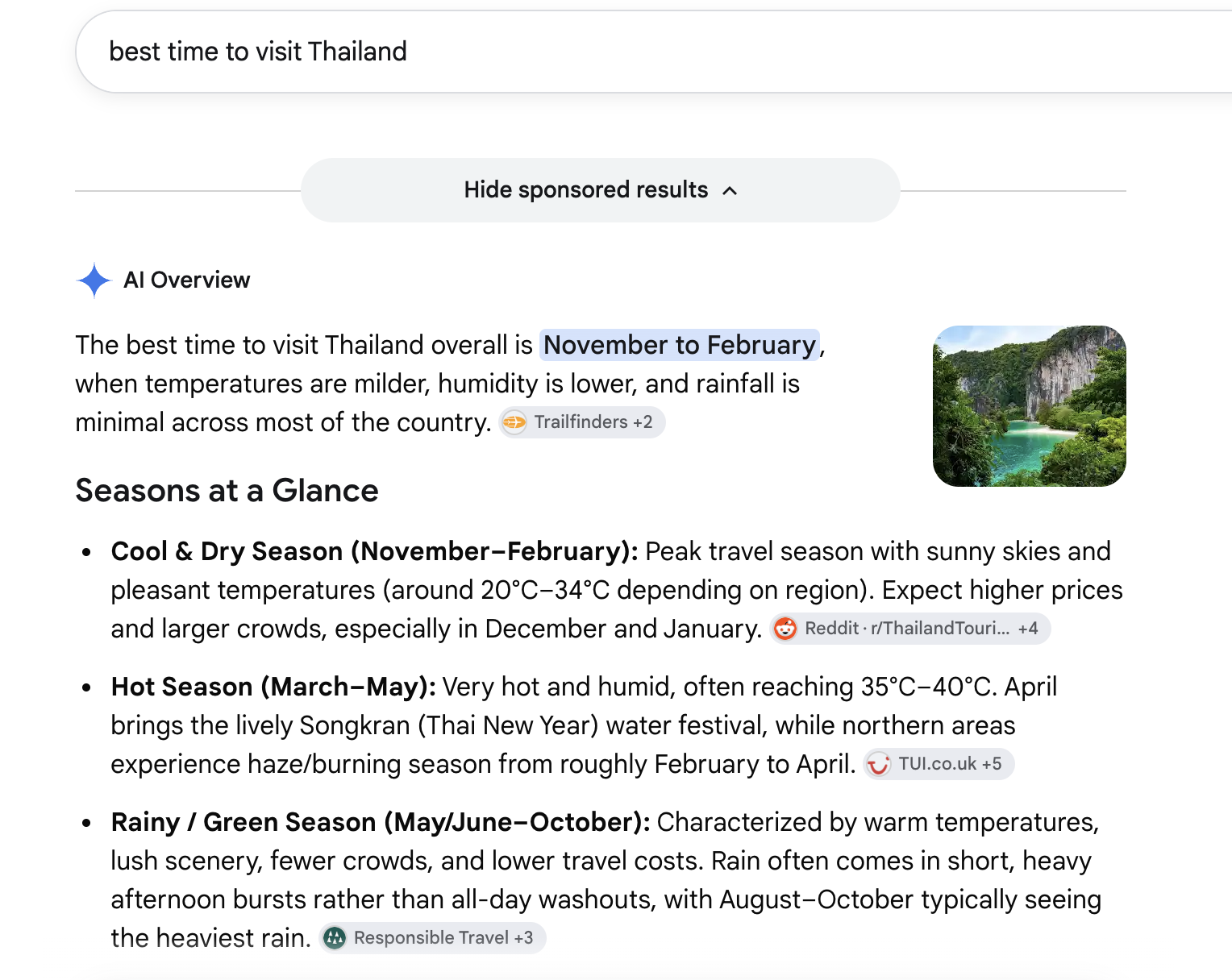
That means your content can influence somebody without earning the click that would traditionally have proved it (you can read more about this in our recent article Where did all the clicks go?).
If organic traffic drops in 2027, don’t immediately assume something has gone awry. Look at the search results themselves. Has an AI Overview appeared?
The chart below from Advanced Web Ranking shows how AI Overviews have grown in the world of travel in in the last 12 months:
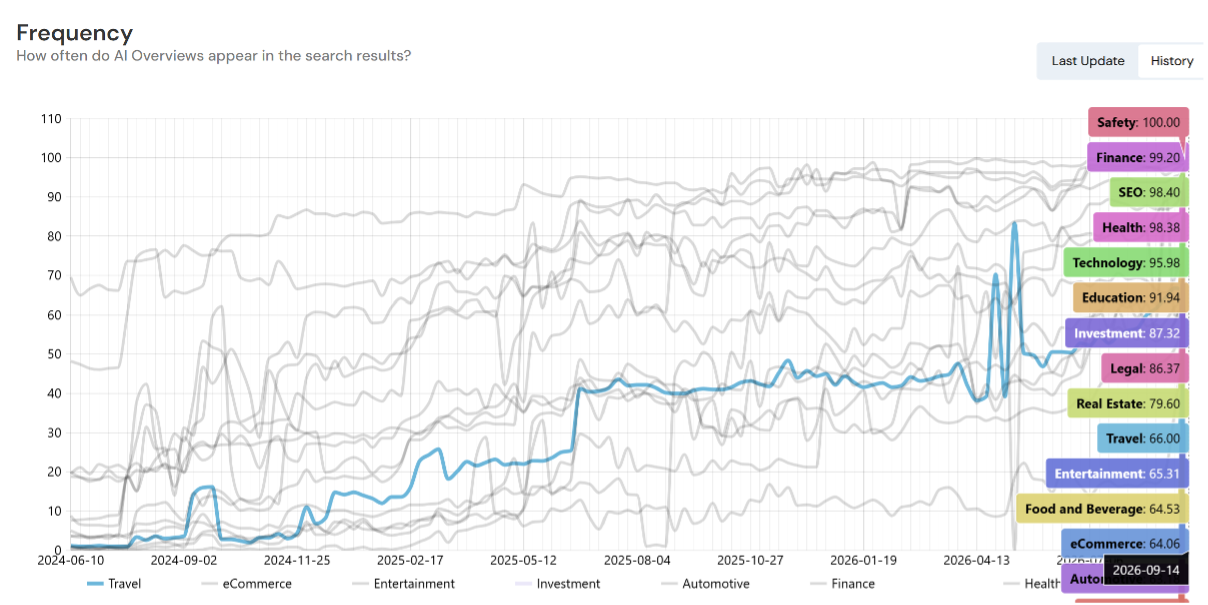
You also need to review if Google has started favouring a different type of content. Are enquiries and bookings moving in the same direction as traffic?
Clicks still count obviously, but they’re becoming a softer measure of how much influence your brand has during the travel research process.
2. Sort out the data you’re feeding into paid platforms
Silvia’s biggest recommendation for 2027 was probably the least glamorous: get your tracking right.
Google and Meta now do far more of the heavy lifting inside paid campaigns. The days of spending hours tweaking individual bids and building dozens of tiny ad groups are disappearing, which means the quality of the information you feed into those platforms becomes even more important.
Take a quote request. Google sees somebody complete the form and records a conversion. As far as the platform is concerned, job done.
Google doesn’t know that the enquiry went nowhere unless you tell it.
If every form submission is treated as equally valuable, the system will keep trying to find more people who behave in the same way, regardless of how many eventually become decent leads or bookings.
Connecting CRM data back into your advertising platforms gives them a much better idea of what success actually looks like. Ideally, you want the platform to know when an enquiry turns into a booking. If you don’t generate enough bookings to provide enough data, you can optimise towards quotes instead. At the very least, Silvia recommends feeding back qualified leads.
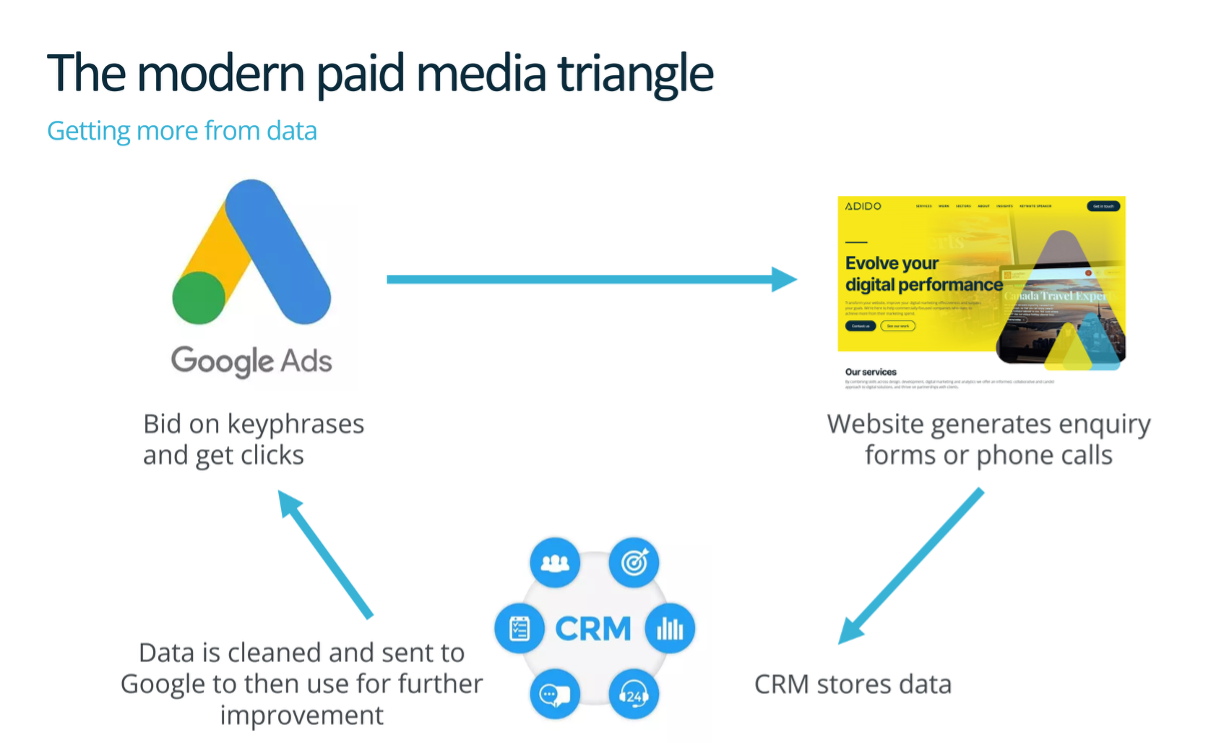
(We've had the diagram above in our slide deck for many years now and it’s still completely relevant in 2027!)
There’s another job to do before any of that happens though - get sales and marketing to agree on what a qualified lead actually is.
If one team thinks an enquiry is brilliant and the other thinks it’s rubbish, plugging more systems together isn’t going to solve much.
As Silvia put it in the webinar: ‘Feed the machine garbage data and get garbage ROI’.
3. Give your paid campaigns more creative to work with
Creative is starting to do some of the job that targeting used to do, particularly on Meta.
Advertisers once spent a lot of time manually deciding exactly who should see an ad. Meta is increasingly using creative itself as a targeting signal, looking at what’s in the ad and matching it with people who are more likely to respond.
Silvia used a few very travel-specific examples during the webinar (watch it here!). An overwater bungalow in the Maldives is likely to appeal to a very different traveller than a family waterpark, which is why relying on one image and one headline is going to make things tricky.
The platforms need enough creative to test. They also need enough variation to understand which messages appeal to different audiences, so having a decent bank of imagery and video becomes much more valuable.
Speed is important too. If an ad starts to tire, how quickly can you get something new live?
This is one area where AI tools can genuinely help, especially if the bottleneck is simply the time it takes to produce enough material. But producing more content only helps if it still looks and sounds like you.
Set the guardrails first. Decide what you’re happy to automate and make sure somebody is checking the output before it goes anywhere near a customer.
4. Check what Google is actually ranking before creating more content
One of the repeated conversations Tom and the SEO team have been having with clients is around search intent.
A page can perform well for months and then start losing rankings even though nothing obvious has changed on the page itself. Sometimes Google has simply decided that people searching for that phrase want something different.
Tom used ‘Greece honeymoon’ as an example.
In the past, that search returned more commercially focused pages from travel brands. More recently, Google has leaned towards informational content and advice-led guides.
So if an important page starts slipping, search the term and look at what Google is actually showing before deciding what to fix.
The answer may be that your page needs improving, or that the type of page Google wants has changed completely.
There’s another area travel brands should make more of in 2027, and that’s the expertise already sitting inside the business.
Destination specialists come back from research trips with the sort of detail that generic travel content struggles to replicate. They know what surprised them, which experiences they’d recommend and the practical stuff a traveller would genuinely want to know.
Capture it.
Your destination experts don’t need to become full-time writers. Put a process in place to collect their notes, anecdotes and advice, then use that material when content is created.
AI can help with the writing process to a certain extent, but asking it for 1,000 words on a Botswana safari with nothing more than a vague prompt is unlikely to produce something another travel brand couldn’t generate five minutes later. The quality of what goes in still counts – especially in light of growing anti-AI sentiment among consumers.
5. Make your digital PR do more for SEO
Digital PR has become a much bigger focus for brands over the past year, with AI visibility adding another reason to care about where and how your business is mentioned online. But there’s also a more immediate SEO opportunity that often gets overlooked.
A strong PR campaign might very well earn coverage and backlinks from relevant publications, but if all that authority lands on a campaign page that sits largely on its own, the commercial pages you really want to rank won’t see much benefit.
A bit of joined-up thinking, however, can make the same campaign work much harder.
Before a PR campaign goes live, have a poke around the site and identify which areas could do with more SEO support and where internal links from the campaign content would make sense. That way, some of the authority earned by the campaign can flow through to the destination, product or category pages that matter commercially.
You still get the brand coverage and backlinks the campaign was designed to generate, but you’re also giving priority pages a better chance of benefiting from the investment.
What should travel marketers be doing differently in 2027?
One thing came through pretty clearly in the webinar. Some of the levers travel marketers have relied on for years are moving further out of our hands.
Google is making more of the decisions inside paid campaigns, search results are harder to predict and more of the research journey is happening before someone reaches your website.
That makes the basics more important than ever. Good data, genuinely useful content, keeping a close eye on what’s changing and making sure your teams aren’t working in silos will all count for a lot in 2027.
None of that is especially flashy, but it’s practical. And after the year we’ve just had, practical feels like a pretty sensible place to start.


