Anyone working in SEO has spent the past few years watching Google become increasingly reluctant to let anyone leave Google.
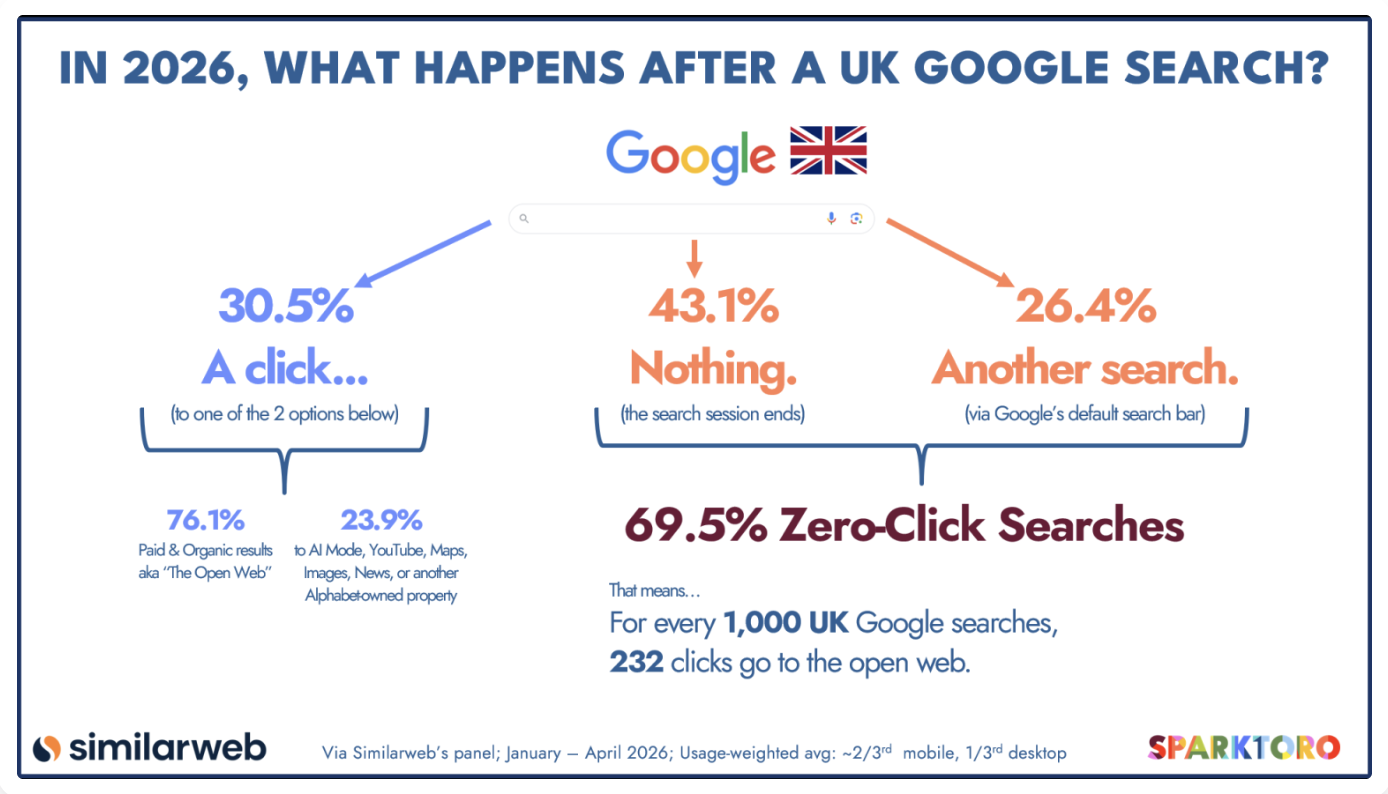
Research published by SparkToro in June 2026 found that 69.5% of UK Google searches ended without a click – that’s over two-thirds of all searches!
And even that doesn’t give us the full picture. Of the searches that do result in a click, some simply send people to another Google-owned property such as Maps, YouTube or AI Mode. Strip those out and just 23.2% of UK Google searches send someone to the open web.
So, is it really time to bid farewell to the once-almighty click?
Well, not quite…but perhaps we should start drafting the eulogy.
Zero-click search itself is hardly new. We wrote about how to win in a zero-click world back in May 2025 and have been talking about it since…well, for as long as I can remember, so we’re not going to pretend this is some jaw-dropping curveball. Google has been answering queries directly for years through featured snippets, maps, knowledge panels, flight information and various other SERP features, making a set of ten blue links feel positively old school.
In light of that SparkToro stat, it’s worth exploring the question: what happens when your marketing influences the holiday but never gets the click?
Travel is particularly vulnerable to zero-click searches
Travel has always been research-heavy, especially when it comes to finding and booking holidays.
Someone looking for a dream getaway to Japan, for example, will typically search for the best time to go, how long they need, where to stay, whether the rail pass is worth buying, what Tokyo is like in August and what there is to do once they get there.
A lot of those searches once resulted in clicks.
Now Google can answer many of them on the results page. ChatGPT, Gemini and other AI tools can go considerably further, keeping the traveller in the same conversation as one question leads to another, while the systems themselves may fan the query out into multiple searches behind the scenes.
And many of us are now using these tools. MMGY Travel Intelligence research reported this year found that 52% of UK travellers use AI tools to help plan holidays, up from 40% in 2025.
That 52% figure tells us AI is already part of the planning process for a sizeable chunk of UK travellers. However, it doesn’t tell us exactly how they’re using it.
For a closer look, let’s hop across the Atlantic. As part of its State of AI Visibility for Travel in 2026 report, travel marketing agency Propellic followed 38 travellers for a week as they used AI to plan real trips. Participants were happy to use it for discovery, comparisons, shortlisting and itinerary planning, but many still wanted control when it came to the booking itself.
For multi-day trips, none of those 38 participants went looking for a guided tour operator. They asked AI to build an itinerary and AI duly built one. It’s worth bearing in mind that this is a small qualitative study, so we wouldn’t suggest tour operators everywhere start boarding up the windows just yet, but the behaviour is worth paying attention to.
AI influence is growing faster than AI traffic
Our own analysis of 41 UK travel websites found that LLMs accounted for just 0.37% of all website visits between January and April 2026, up from 0.12% a year earlier.
So while AI is clearly becoming part of the travel planning process, the scale should be kept in perspective. More travellers may be using AI along the way, but Google still absolutely dwarfs it when it comes to overall search volume. In fact, SparkToro estimated that Google was still handling more than 210 times as many searches as ChatGPT in September 2025.
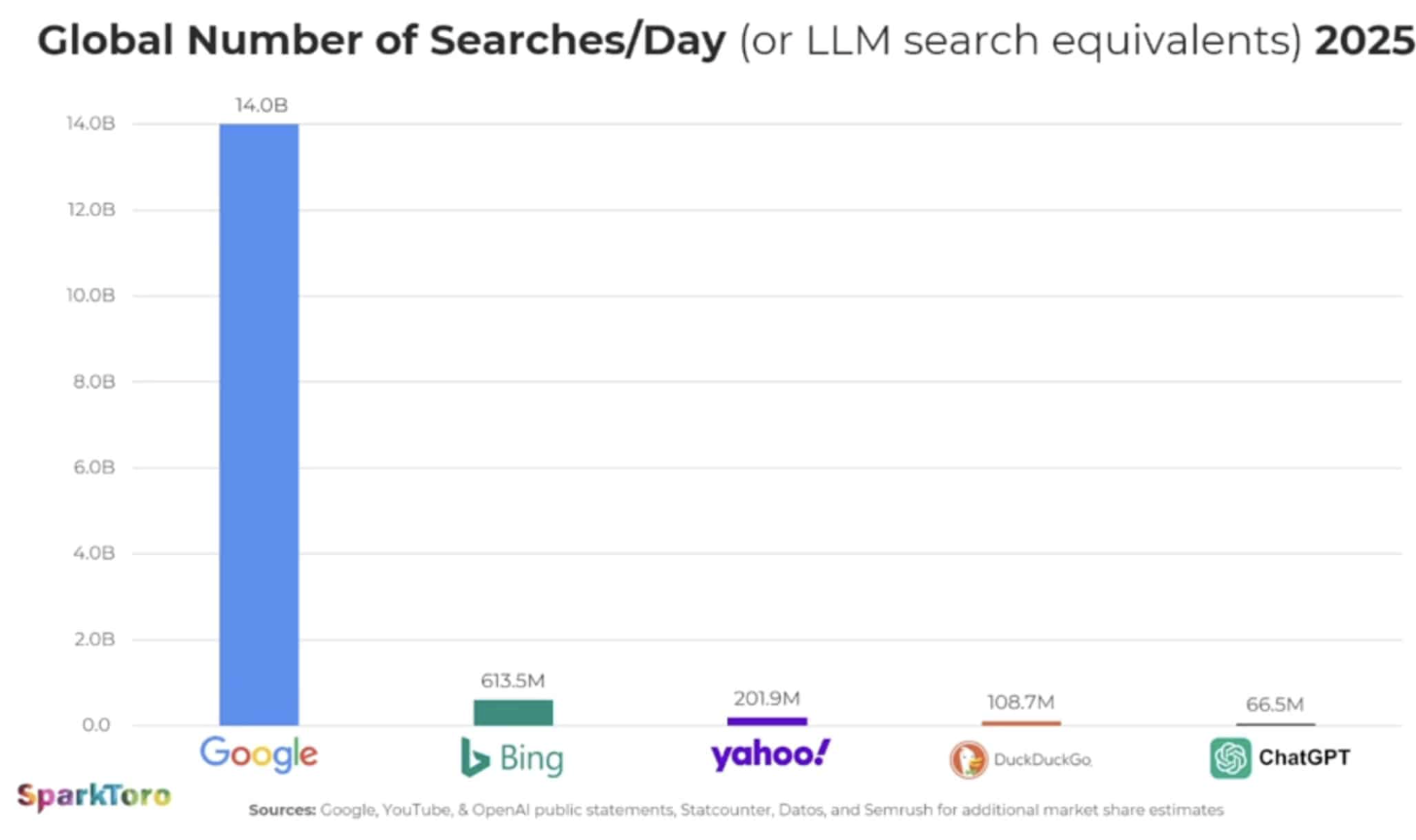
And that brings us back to the real issue. Travellers moving from Google to ChatGPT are only one small part of what’s happening. Google itself is increasingly answering searches, suggesting the next query and keeping people within its own digital four walls.
The September Travel Trends report shows how little of that AI activity is translating directly into bookings. LLM referrals account for under 1% of Booking.com room nights, while Eurostar says they generate around 0.8% to 1% of tickets.
Yet the same report cites Mastercard research suggesting travellers who plan using AI account for roughly twice the accommodation wallet share.
A channel can influence someone without appearing as the neat little source/medium label beside their eventual booking.
Someone could find your brand in an AI-generated itinerary, look you up on Google three days later, visit again directly the following week and finally enquire after opening an email.
Google Analytics will dutifully give us some numbers, but it won’t necessarily tell us which bit made them want you in the first place.
Traffic down doesn’t automatically mean SEO down
Imagine your non-brand search impressions increase, organic sessions fall 15%, branded searches rise and enquiries remain steady.
Before calling it an SEO problem, look at what happened around those missing clicks.
Search Console impressions, SERP visibility, direct traffic and other indicators can help fill in some of the gaps, but the trick is not replacing one blunt KPI with another 17-column dashboard nobody understands.
Start by separating searches according to the job they’re doing.
A query such as ‘weather in Lisbon in April’ can be answered almost entirely without leaving Google. Losing clicks there is very different to losing them for ‘private two-week Mauritius honeymoon itinerary’ or a branded search for one of your holidays.
Then look at the signals together. Falling clicks alongside rising impressions, branded demand and enquiries tell one story. Falling clicks, declining brand searches and fewer enquiries tell another.
Some clicks probably deserve to die
Forgive the somewhat OTT header, but it’s true that some clicks are pretty worthless.
If the only thing your page does is provide a straightforward answer that Google or an AI tool can reproduce perfectly well, persuading somebody to visit it is going to become harder.
Travel brands have a better hand to play than many sectors because holidays are typically emotional - and often pricey - purchases. A generated answer can easily tell someone where to spend four nights in Costa Rica but it’s much harder for that answer to replace a detailed, customised itinerary with real, first-hand advice and the reassurance that somebody competent will sort things out if things go wrong (which they often do).
Propellic’s tour operator findings are particularly relevant here. It recommends publishing the specific elements of an itinerary, including named guides, individual sites, permits, private access and what happens each day, so AI systems have something concrete to draw on when they assemble an answer.
That leaves travel marketers with two jobs:
- Give AI enough accurate information to recommend you.
- Give the traveller enough reason to click on you.
That second part is easily forgotten in the rush to ‘optimise for AI’.
Don’t try to buy back every lost click
Google is hardly likely to be devastated by the decline in organic clicks. Paid search is doing just fine and that’s all it really cares about ultimately.
But treating paid media as the automatic replacement for every visit lost to zero-click search would be far too simplistic. Not every click has the same value, and some of the easiest ones to lose are also the least likely to turn into anything commercial.
The priority should be the searches where a click still has real value. High-intent queries, branded searches and more complex research questions are the ones worth fighting harder for, particularly when the traveller needs something beyond a quick answer.
SEO still has a job to do even when the visit never happens. SparkToro makes the point that website content can still influence what people see in AI products and Google’s own zero-click features, even if the user never reaches the original page.
So, RIP the click?
Nah, there’s life in the old dog yet. The click won’t be clocking off any time soon.
A click from somebody comparing an itinerary, checking availability or deciding who gets several thousand pounds of their holiday budget is still hugely valuable.
We’re just going to get fewer of the easy and noisier ones.
And as more of the travel research journey happens without a website visit, counting clicks alone is going to leave a fairly hefty gap in the story.


