I have spent more time in airports these last couple of years than I care to remember.
Is it because I can’t get enough of dousing myself in fancy duty free perfumes I have no intention of buying or because I love spending half my mortgage on a small glass of wine and a packet of nuts?
It’s actually neither. My airport loitering has been entirely down to delays. (Oh, and queues…but that’s a rant for another day).
And this week’s UK air traffic control shitshow hasn’t helped either. A technical problem at NATS caused widespread disruption across the country, with hundreds of flights cancelled and many more delayed. While I wasn’t directly caught up in it all, my parents (at time of writing) find themselves stuck in Barcelona and a colleague has been left stranded in Berlin.
This begs the question… are delays and cancellations getting worse?
Flight disruption feels increasingly commonplace. There’s always another headline about airport chaos, air traffic control problems, strikes, diversions, etc. Enough, at least, to make me wonder if my own bad luck is part of something bigger.
Flight disruption certainly feels like more of a thing
My ranty pessimism isn’t enough to confirm my suspicions, but a quick look at Google Trends did initially seem to back up my argument.
Worldwide search interest in terms such as ‘flight delay’ and ‘flight cancellation’ over the past five years paints an interesting picture. Both terms are seeing much bigger spikes than they did earlier in the period, particularly over the last year or so.
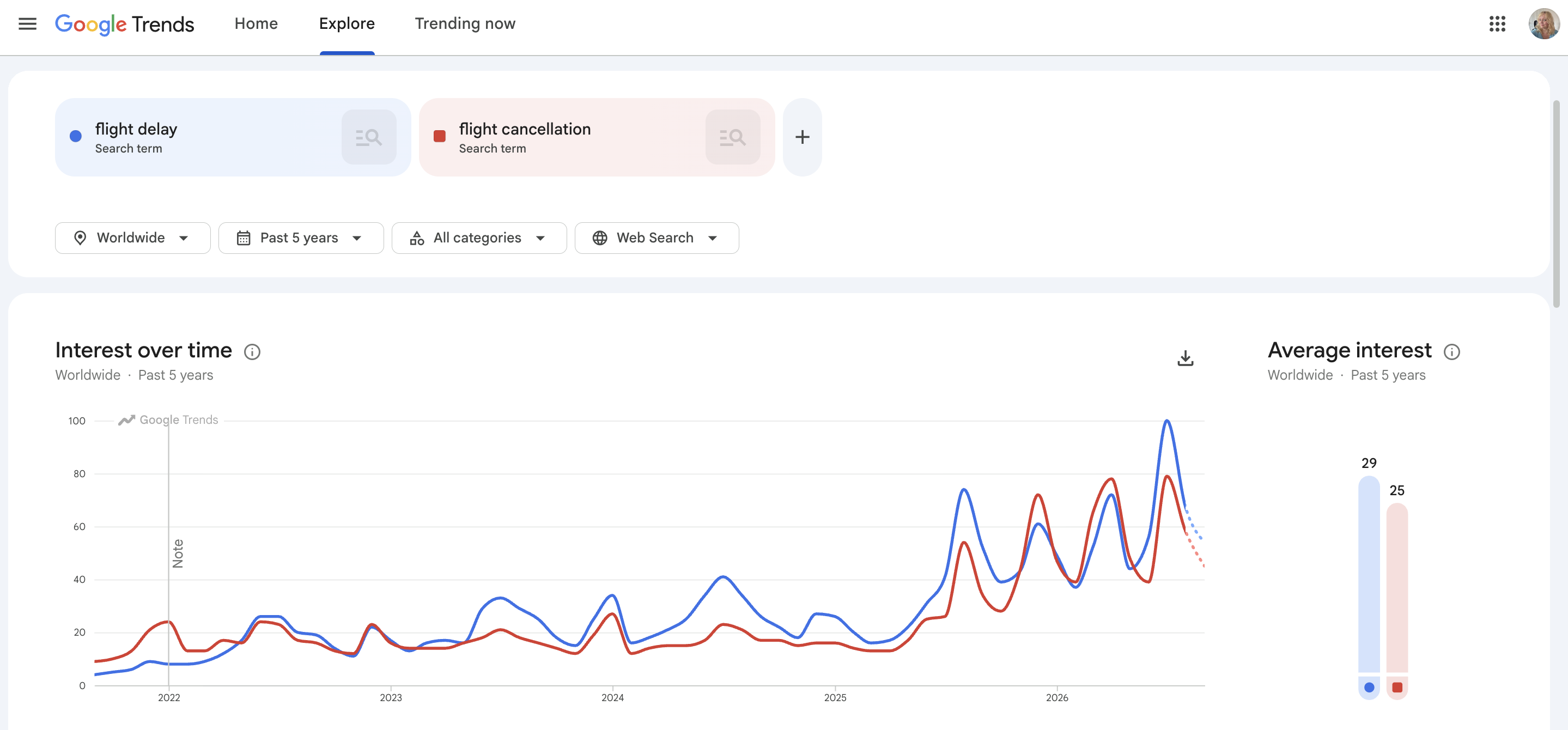
Google Trends needs to be approached with caution though. It measures relative search interest rather than the number of searches, so we can’t look at that graph and conclude that delays themselves have increased by the same amount.
What we can say is that flight disruption appears to be occupying more of people’s attention.
But while our perception might be that delays and cancelled flights are on the up, the data tells a different story.
Europe is actually getting more punctual
EUROCONTROL’s Assessment of Air Traffic Management in Europe gives us a pretty good overview of what’s happening across European aviation.
In 2025, 76.1% of flights arrived within 15 minutes of schedule, up from 72.5% in 2024.
Average departure delay also came down, from 17.7 minutes per flight in 2024 to 14.7 minutes in 2025. Even the summer months improved, with arrival punctuality rising from 64.5% in summer 2024 to 71.1% in summer 2025.
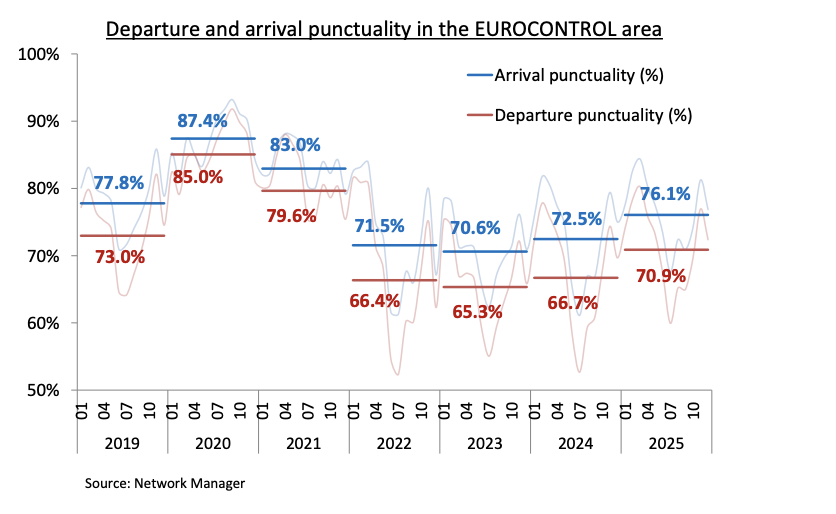
Go back a couple of years though and you can see why flying may have gained such a poor reputation.
EUROCONTROL describes 2022 and 2023 as the lowest punctuality levels in two decades. Demand came back quickly after Covid but airports, airlines and air traffic control struggled to scale their operations at the same speed, with staffing shortages playing a major part. Arrival punctuality dropped to 71.5% in 2022 and then 70.6% in 2023 before beginning its recovery.
We’re still slightly behind 2019. Back then, 77.8% of flights arrived within 15 minutes of schedule and average departure delay was 13.2 minutes. That being said, anyone remembering a glorious pre-Covid age when every flight left or arrived bang on time may still be looking through somewhat rose-tinted glasses, but the data does show a small gap.
It’s also worth noting there are more flights taking to the skies than ever before.
In 2025, there were 11.1 million controlled flights across the EUROCONTROL area, 4.3% more than the previous year and fractionally above 2019. Passenger numbers were 8.6% higher than in 2019 too.
That makes the improvement in punctuality all the more noteworthy, given the network is handling greater numbers of flights and passengers than it was before the pandemic.
US figures are less promising
According to the US Department of Transportation, 76.42% of reported flights arrived on time in 2025, down from 78.10% in 2024. In 2019, the figure was 79%.
That means American punctuality moved backwards last year and remains noticeably below its pre-pandemic level.
It’s a similar story for cancellations too, with a rate of 1.53% in 2025, compared with 1.36% in 2024. The US airline market is also highly concentrated, with four carriers controlling around 80% of air traffic. That gives passengers fewer alternatives when things go wrong and reduces the competitive pressure on airlines to improve.
There’s evidence that this can feed through into punctuality too: one US government study found that when the number of competing airlines in a market fell from three to two, delays increased by 25%.
European aviation is therefore performing better than its US counterparts and is also less concentrated, giving passengers more choice and airlines more reason to keep standards up.
What can travel brands do?
This is the bit I find most interesting as I’m approaching the question from the perspective of a disgruntled traveller and someone with a professional interest in the industry.
Google search behaviour suggests delays and cancellations are becoming a bigger concern for travellers at the same time that European flight punctuality is getting slightly better.
But customers aren’t booking their holiday with a EUROCONTROL performance report open in another tab. Their view of flying is being influenced by their own experiences, social media, stories from friends and family and news headlines, such as the NATS issue this week.
So how can travel marketers drown out the shouty headlines and social media rants that help perpetuate the doom-and-gloom narrative?
Realistically, they can’t. And in many cases, they won’t even be the ones controlling the information passengers are receiving. Airlines, airports and air traffic control bodies all have their own comms channels.
Where travel brands can help is by explaining what that disruption actually means for their own customers.
A delayed flight might be one line on an airport departure board, but for a tour operator’s customer it could mean a missed transfer, a late hotel check-in or uncertainty around the first day of an itinerary.
This is the bit the brand can help with.
If a flight is delayed, does the transfer still run? If the traveller misses a connection, who do they contact? If they’re arriving several hours late, what changes at destination? Those are questions the airline may never answer because they sit outside the airline’s responsibility.
Good comms in that situation should explain what the disruption actually means for the customer’s holiday and what happens next.
So, are flight delays really getting worse?
No. At least, not in Europe. So I begrudgingly have to concede that my own experience isn’t especially representative.
Not that this helps my folks currently stuck in Barcelona or my colleague in Berlin.
And it probably won’t stop me swearing at the departure board the next time my flight slips from 10.00am to 3.00pm.
But at least that’s five extra hours in duty free.


