The theme of this year’s ATAS conference was ‘Accelerate’, with Silverstone providing a fitting backdrop for two days of discussion about where touring and adventure travel is heading.
The session names followed the racing theme, with everything from ‘Rear-view mirror’ and ‘In the driving seat’ to ‘The next lap’.
The programme was primarily designed to help travel agents sell touring and adventure holidays more effectively, but there was plenty for travel marketers to think about too. What do today’s touring customers actually want from a trip? How does that differ between audiences? And are travel brands giving people enough information and confidence to book?
I came away from the conference thinking that demand for touring remains strong, but the range of people, places and experiences within the sector has become much harder to sum up in one neat and tidy proposition.
Here are some of the moments that stayed with me and what I think travel marketers can take from them.
Rear-view mirror: who is actually booking touring holidays?
The opening ‘Rear-view mirror’ session looked at the latest ATAS member research, with the figures shared showing growth in bookings and passenger numbers and stronger growth reported through agents.
That resilience came through in the discussion despite the continued uncertainty around costs and geopolitics.
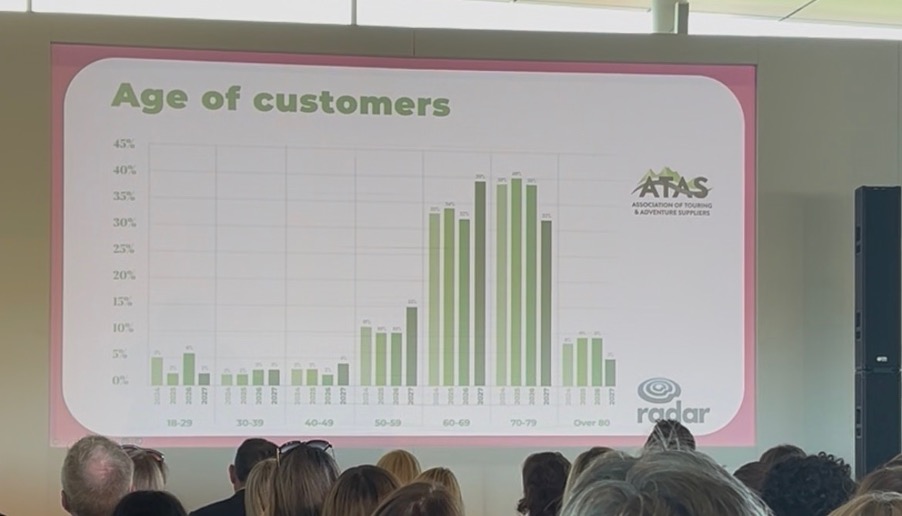
The age profile was revealing too. Customers aged 60 to 79 still account for a substantial share of bookings in this market, which is useful context for anyone making decisions about media plans, website content or the booking journey.
There can sometimes be a tendency to associate adventure travel with people in their twenties and thirties, but that clearly doesn’t tell the whole story. It’s also worth bearing in mind that the destination trends presented through this research are heavily skewed towards an older demographic.
Of course, that doesn’t mean one message is going to work for everybody aged 60 to 79 either.
Someone booking their first escorted tour may want reassurance around the pace, what’s included and how much support they’ll have along the way. Someone who has travelled extensively may be much more interested in access, depth of experience and where an itinerary goes beyond the usual stops.
In the driving seat: which destinations are growing?
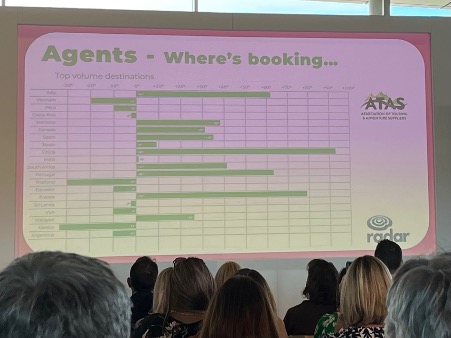
The highest-volume destinations in the data included Italy, Vietnam, Peru, Costa Rica, Morocco, Canada, Spain, Japan, China and India, although the direction of travel differed considerably between them.
Morocco, Canada, Spain and China showed strong year-on-year growth, while Vietnam and Peru declined. The panel also discussed softer interest in the USA.
The operator panel, which included Exodus Adventure Travels, Incredible Journeys, Travelsphere and HX Expeditions, added some context to the numbers.
Travelsphere talked about growing interest in Central Asia and Silk Road itineraries, Scandinavia and the Arctic, while Exodus highlighted demand for some less obvious destinations such as Guatemala and Andorra.
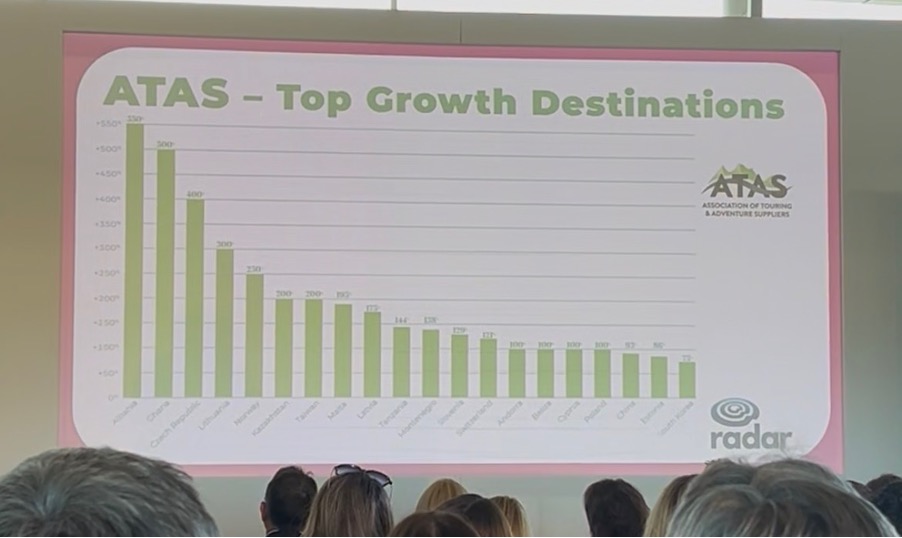
There was also a useful reminder of how much destination performance can vary by operator and product. The earlier ATAS research showed a small decline for Costa Rica, for example, while Exodus reported growth for its own trips there. Then came some of the more eye-catching growth figures. Albania, Ghana and the Czech Republic featured near the top of ATAS’s fastest-growing destinations, with some very large percentage increases.
These figures are insightful, but I’d be wary of getting too carried away without knowing the absolute volumes sitting behind them. A 500% rise sounds dramatic, but it tells you far less about the size of the opportunity until you know how many bookings it represents.
If you’re interested in digging further into destination demand, our quarterly travel trends series looks at changes in search interest and can add some useful context around the volume behind different destinations (our latest Q3 report will be published soon!).
On the grid: the right trip for the right person
One of the more striking comparisons presented during the conference was around solo travel.
Around 43% of bookings in the wider adventure and touring figures were presented as solo bookings, compared with only 9% of bookings made through agents. The discussion suggested solo travel could be harder for agents to sell and that there may be an opportunity for operators to help educate agents more around this type of traveller.
It also made me think about what happens when a solo traveller arrives on a tour operator’s website or starts speaking to an agent.
Can they see the actual price they’ll pay, including any single supplement? Do they understand the group dynamic and if they’ll have time to themselves? Is there a clear answer if they’d prefer their own room? These are fairly basic questions, but they’re likely to matter a lot when somebody is considering travelling solo as part of a group.
The discussion also challenged another assumption, that somebody travelling alone must necessarily be single. One operator talked about customers who were in relationships but simply chose to take certain trips without their partner, which gives marketers a much more useful starting point than treating the whole audience as a ‘singles holiday’ market.
Women continue to be particularly important within the touring sector too. Just You shared that around 70% of its audience is female and that certainly rings true with some of the group trips I’ve taken, where women have often made up the majority of the party.
First-time tourers want something different
Several operators talked about the difference between first-time tourers, who may want to see as much as possible, and experienced travellers who are looking for a slower and more immersive trip with a comfortable place to return to each evening.
If an itinerary page simply lists stops and inclusions, the customer is left to work out what the holiday will actually feel like. What’s the pace of the trip? How much time is spent in each place? What standard of accommodation can they expect? And what makes this particular experience distinctive?
A first-time touring customer may need a clear explanation of how the whole thing works, while somebody who has already done several escorted tours may be looking for a reason to choose this itinerary over places they’ve already visited.
The ‘On the grid’ session also looked at how agents with different business models grow their touring sales and product knowledge came up repeatedly throughout the conference.
There are so many operators and variations of each trip that agents need to understand what distinguishes them before they can recommend one with confidence. Tour operators have a part to play here too, giving trade partners clear comparisons, first-hand experiences and useful sales material instead of expecting them to absorb an ever-expanding catalogue.
Moving up a gear: what happens after the booking?
The ‘Moving up a gear’ panel looked at ways to turn a good booking into a better one, covering areas such as premium cabins and rooms, smaller groups and holiday extensions.
Separately, one operator said that customers booking between March and May had been looking further ahead than usual, often towards travel the following year.
We shouldn’t assume that applies equally to every product or brand, but it does make the period between booking and departure more noteworthy. Once flights, room options, extensions or other experiences become available, there may be a perfectly sensible reason to get back in touch with somebody who has already booked.
The timing and offer need to make sense for the traveller though. A generic sequence of upgrade emails is unlikely to achieve much.
Start by looking at the gap between booking and travel across different products and identifying the points where another contact could genuinely add something to the holiday. That might be a cabin upgrade, extra nights or a local experience, but it could equally be practical information that builds confidence and keeps the customer engaged before departure.
Changing tracks: rail travel is becoming part of the holiday
Rail travel came up repeatedly during the conference, with Railbookers, Explore Worldwide and The Armstrong Collective discussing its growing appeal.
The speakers talked about increasing media exposure, wider interest in slower travel, sustainability considerations and the simple appeal of enjoying the journey itself. There was also discussion around people who fear flying or have been put off by rising air fares.
Luxury rail adds another dimension, particularly as demand for luxury travel grows. Sleeping cabins, food and the overall onboard experience can all become a big part of the attraction.
The panel talked about well-known rail journeys in places such as Switzerland, Italy, Canada and Norway, alongside some less obvious options in France and Spain and journeys to Sicily.
As rail is still a relatively small part of touring, the panel suggested starting with shorter and simpler routes for customers who haven’t considered this type of holiday before.
There’s plenty for marketers to work with here if the route genuinely adds something to the overall trip, particularly when the scenery, stops along the way or onboard experience become part of what somebody is actually booking.
Road-tested: travel content needs to be worth sharing
The Mail Metro Media ‘Road-tested’ session made a pretty straightforward point about travel content: find a fresh angle and show that somebody actually knows the destination they’re talking about.
First-hand images, a useful opinion or a specific experience will usually give somebody far more to engage with than another interchangeable destination description.
The discussion around social media caught my attention too, particularly the idea that a lot of engagement happens privately. Somebody may never like or comment on a piece of content, perhaps because they aren’t somebody who conspicuously interacts with posts or because sending it to someone else feels like a more private exchange. That means a post being passed directly to a friend could be every bit as valuable as one collecting lots of visible likes and comments.
The speakers also talked about episodic content and giving people a reason to come back, including series-based content, ‘watch to the end’ storytelling and top tens.
I can see the appeal, although I’d be cautious about holding back the useful bit purely to keep people watching. If the payoff repeatedly disappoints, people are going to notice.
Video remains an important part of the mix. Short-form content continues to suit reels and social posts, while longer videos of around nine to 15 minutes were suggested for YouTube, particularly where there’s more educational content, behind-the-scenes storytelling or expert commentary involved.
The planning and storyboarding stage was also highlighted as particularly important when creating longer-form or series-driven content. The panel described social platforms increasingly behaving like interest networks too, with content reaching people beyond an account’s existing follower base.
That gives brands with a clearly defined niche more chance of reaching the right people. ‘Adventure travel’ covers an enormous amount of ground, while a particular traveller, experience or question gives a brand much more to say.
Off the beaten track: Selling the reality of wildlife travel
Lizzie Daly’s ‘Off the beaten track’ keynote and the ‘Driven by nature’ panel brought the conversation back round to something that can easily disappear when a travel product is reduced to a list of amenities and inclusions.
A safari or expedition has an emotional side that can be difficult to capture in a conventional product description. There’s the anticipation of a sighting, the sounds around you and the feeling of being somewhere vast and unfamiliar.
Having been on a safari trip myself, I know how difficult it is to describe the moment you first see an animal you’ve been hoping to find. In my case it was a leopard in South Africa, followed by an elephant which I initially mistook for a very large rock!
This sort of personal experience can make great content, but there also needs to be honesty around what can be promised. Wildlife and nature don’t work to an itinerary and there are never any guarantees around sightings or perfect weather. That uncertainty is part of the experience and good storytelling can prepare people for it without creating the impression that every traveller will have exactly the same moment.
For some brands, one genuinely useful itinerary walkthrough or an honest explanation of who a wildlife trip suits could do far more for enquiries than producing a large volume of generic posts.
Full throttle: listen to what loyal customers book next
Wendy Wu’s keynote had exactly the sort of energy you would hope for from a session called ‘Full throttle’, but one point in particular stuck with me.
The business had asked customers what they did between their touring holidays and found that some were taking cruises or beach holidays. As a result, Wendy Wu Tours then started developing trips that combined those experiences with touring.
I thought this was an interesting way of approaching product development because it starts with what existing customers are already telling you through their wider travel habits.
For a brand with loyal travellers, understanding where else they go and what they book between trips could uncover opportunities that might be missed if you only look at what they currently buy from you.
The next lap: what should travel marketers take away?
ATAS finished by looking ahead to new campaigns, training and resources for members, which felt appropriate after two days where the value of better-informed agents came up repeatedly.
If the industry wants more people to try touring, agents need enough knowledge to explain why a particular trip is right for a particular customer and brands need to make that job as easy as possible.
For me, one of the biggest takeaways from the conference was simply how difficult it has become to talk about ‘the touring customer’ as though they’re one type of person looking for one type of holiday.
First-time tourers and experienced travellers can want very different things. Solo travellers have their own questions and concerns. The same destination can perform very differently between operators and some of the biggest percentage increases can look rather different once you know the volumes behind them.
Industry data can point you in the right direction, but your own customer data tells you far more about who is actually buying. Look at age, party type, previous trips and booking lead times alongside the wider figures to build a clearer picture of each product’s audience.
The same applies to how those products are marketed. Pace, group size, comfort, inclusions and the nature of the experience all help somebody work out if a trip is right for them, and first-hand stories can help bring that experience to life before they book.
Then there’s the period after booking, which could last many months. Useful, relevant communication during that time can answer questions, maintain excitement and sometimes create opportunities to add something more to the holiday.
And after two days at Silverstone, I’d say there’s plenty of fuel in the touring market tank.


