After a tricky start to 2026, many of us in the travel world hoped Q2 would bring something more positive. By the end of March, however, that optimism had faded as conflict between the US and Iran escalated. The months that followed brought significant losses in pipeline, enquiries and demand across large parts of the travel sector.
Many of our clients were directly affected by global events. As the quarter progressed and the situation began to settle, demand started to recover. By the end of June, things had picked up considerably, which came as a huge relief.
At the time of writing, tensions between the US and Iran appear to be rising again. This time, the story doesn’t seem to be dominating the headlines in quite the same way and much of the rhetoric feels familiar. What happens next is anyone’s guess, but we hope any effect on travel is limited and short-lived.
With the data and trends from last quarter still fresh, let’s take a closer look at what happened.
Headlines
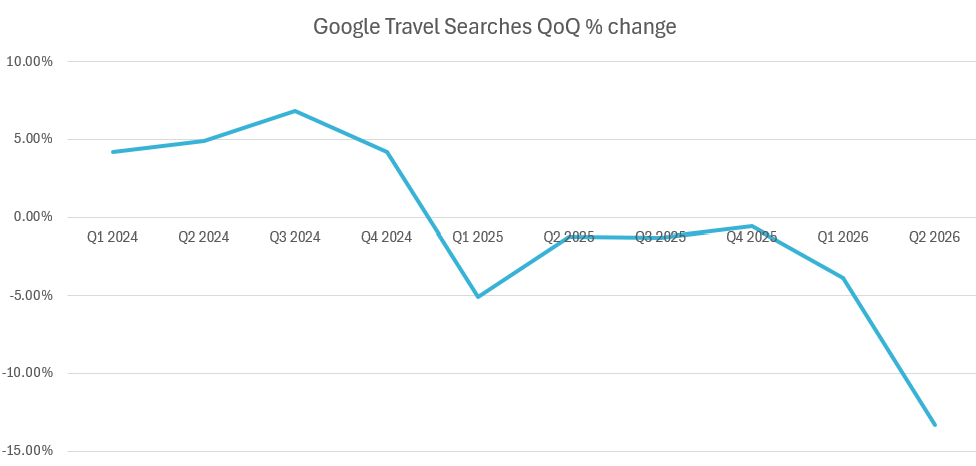
- Overall travel searches were down 13% year on year, following the 3.9% decline recorded in Q1. This was the biggest quarterly fall we’ve seen since Covid and continues the broader pattern of fewer travel searches taking place on Google, at least within the data we’re able to track.
- The ski sector suffered most in Q2, with searches down 46% year on year. One possible explanation is that skiers are delaying their research for 2027 even further, in line with the changes to booking patterns we’ve seen in recent years. Record-breaking temperatures may not have helped either, with snow unlikely to have been front of mind for many people.
- Luxury travel searches held firm at 2025 levels. Perhaps more surprisingly, UK holiday searches were down 10% for the quarter, although much of that fall came over Easter. May recorded a small increase before demand edged down again in June.
- For all the talk of a staycation boom this year, the search data doesn’t support it yet. It will be especially interesting to see what happens in the lates market for July and August.
- North America recorded the largest regional decline, down 41% compared with Q2 2025 and reaching its lowest level since our post-Covid records began. This followed some healthy increases in US searches during 2025, although those may have been influenced by interest surrounding the 2026 World Cup.
- In Europe, our traditional favourites all suffered with countries like France, Germany, Greece and Italy all losing roughly 25% searches YoY. Turkey was the biggest loser was a drop of 40% of searches which has been consistent through all of 2026 so far.
Top movers for Q2 2026 v Q2 2025
There were some surprising names among Q2’s top movers, although perhaps fewer surprises for anyone who watched Race Across the World on the BBC.
With ‘destination dupes’ still appealing to many travellers, Montenegro, Bosnia and Herzegovina, Uzbekistan and Kazakhstan all recorded strong growth.
Montenegro may be emerging as 2026’s Albania, although Albania itself has held onto its position as a genuine go-to destination for UK travellers. Further afield, Panama and Jamaica also grew. Both may have benefited from travellers looking beyond the Middle East, as well as continuing interest from the cruise
Country | Q2 2025 | Q2 2026 | Diff % |
Montenegro | 93300 | 148500 | 59% |
Ecuador | 62500 | 85700 | 37% |
Uzbekistan | 5400 | 7400 | 37% |
Bosnia and Herzegovina | 10800 | 14600 | 35% |
Panama | 78840 | 97940 | 24% |
Vanuatu | 19800 | 22800 | 15% |
Kazakhstan | 5100 | 5800 | 14% |
Jamaica | 54300 | 58400 | 8% |
Albania | 150560 | 159590 | 6% |
Top droppers for Q2 2026 v Q2 2025
At the other end of our chart there will perhaps be no surprises of those who saw the biggest drops in demand. Conflict in the Middle East appears to have left a mark on traveller interest, although whether the effect on demand proves lasting remains to be seen.
Despite Cape Verde capturing all our hearts in the World Cup, that interest didn’t carry through into general holiday searches in our data. Search demand fell 47% year on year.
Former UK favourites Cyprus and Turkey also continued to struggle after several years of declining search interest.
Country |
Q2 2025 |
Q2 2026 |
Diff % |
Jordan |
18600 |
10800 |
-42% |
Turkey |
270140 |
155170 |
-43% |
Peru |
40170 |
21620 |
-46% |
Cabo Verde |
170500 |
89800 |
-47% |
Qatar |
51000 |
26400 |
-48% |
Cyprus |
19210 |
9830 |
-49% |
Oman |
29700 |
14400 |
-52% |
Mexico |
213800 |
99240 |
-54% |
Cuba |
58400 |
26100 |
-55% |
Dubai |
41300 |
14960 |
-64% |
Cruise search demand sees drop in Q2 2026
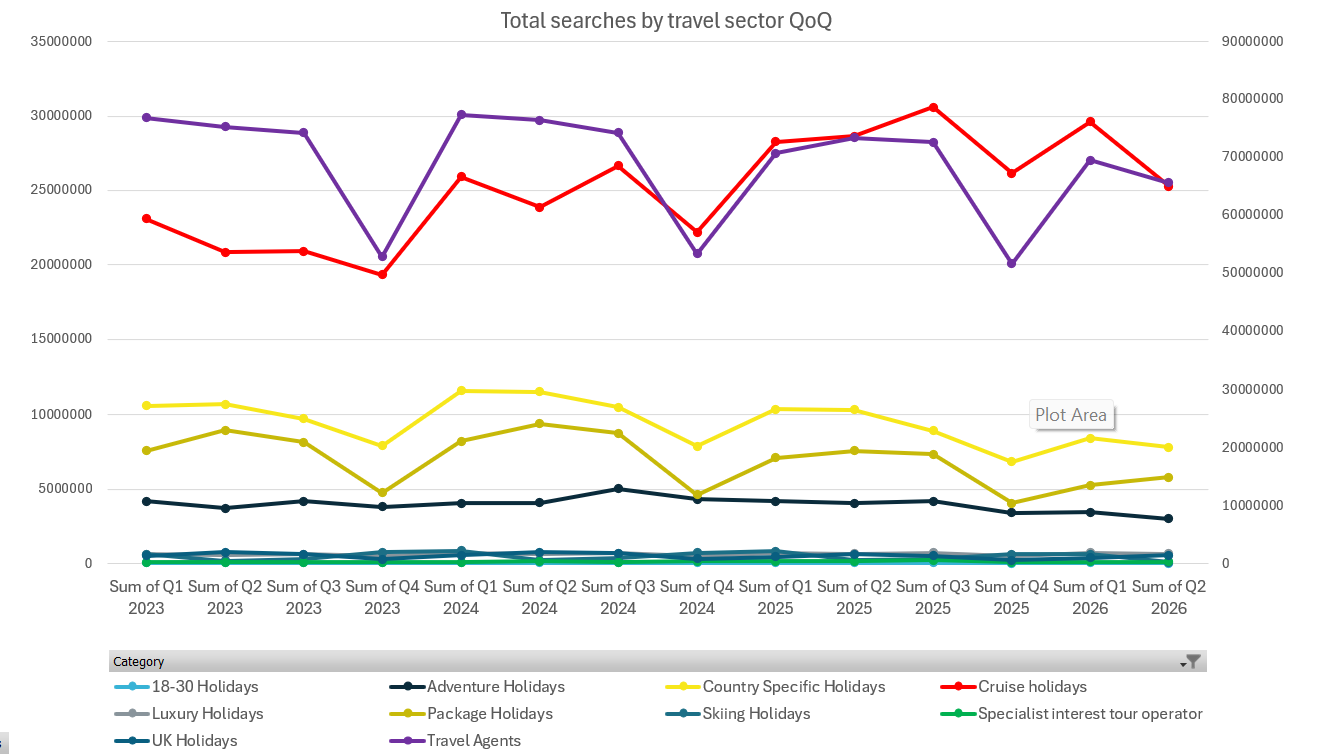
Given the overall decline in Q2, it would be easy to assume cruise searches suffered a steep fall too. Yet cruise has been one of the few parts of travel search to record consistent growth over the past 12 months, even as destinations and other sectors struggled.
In fact, rising cruise interest has supported top-level travel search volumes for several years. Did that continue in Q2?
Well, the short answer is no. This was the first quarter since Covid in which overall cruise searches failed to grow. Volumes fell 11.7%, putting the decline broadly in line with travel agent and UK holiday searches. While disappointing, the fall was less severe than in many other parts of the sector.
Even so, seeing cruise searches dip for the first time since Covid was a notable change. It left cruise only just behind total travel agent searches for the first time in a year.
Summary
As mentioned in our Q1 2026 analysis a few months back, we’re seeing some (big) drops in travel searches across the board for the first time in many years. Overall searches were down for a second quarter in a row, partly due to the Middle East war, perhaps partly due to the general economy, or more unsettling in UK politics, or perhaps due to the very unseasonable weather the UK has seen in many places. Putting it down to one single factor is never correct with so many factors at play. But one thing seems to be coming through in 2026 and that’s searches are starting to fall across the board.
So what? Well, if Google’s data accurately reflects demand and fewer searches are taking place, competition for people actively looking to book will become more intense. PPC auctions are likely to get more expensive, putting greater pressure on bids and budgets for brands trying to maintain click volumes.
Clicks are being attacked both by Google with the continued push of AI powered results, but also with users moving to get influence and attention on other platforms too. If you want to maintain your traffic in both PPC and SEO, there is no doubt you’re going to have to invest extra budget in the years ahead.
Need help deciding where to focus that investment? Let's have a chat!


