It’s now April 2026, although it perhaps feels like it could be the end of the year already, doesn’t it? A heck of a lot has happened. And whilst plenty could still change in the months ahead, we can now look back at the first quarter to see how people across the UK have been searching for travel on Google.
The first quarter of 2026 sadly continues some of the recent trends I’ve noted in earlier looks at online search behaviour, with a gradual overall decline in total numbers. Cruise, however, remains the clear exception and continues to dominate our numbers.
Within our search phrase dataset, January to March 2026 showed an overall decrease in volume of 13% year on year compared to 2025. This is the biggest decrease we’ve seen in the last few years for any quarter and does mean that from a search perspective, the year started on the back foot. Whilst this might seem like bad news, I have to state that searches do NOT necessarily translate into bookings, which often move differently. Some travel companies reported record-breaking sales during peak 2025, while others such as Inteletravel have continued to see growth in 2026.
With that said, the numbers this quarter don’t make for great reading. With overall searches down 13% for the quarter, we have to ask a few questions; is this going to carry on for the rest of the year? Will people search and book later in the season? Are they starting their searches or getting inspiration from other channels?
The answer is mostly a mix of all the above.
What we do know is the numbers are in, so let’s get into it.
Cruise continues to rise while others feel the pinch
I’ve written many times on our Travel Trends pages and talked on countless stages across the UK about how cruise has been an unstoppable force in recent years when it comes general demand online. This year just highlighted it more than ever before, with the amount of cruise-related searches going far and beyond those for (online) travel agents for the first time during peaks. And not just a small jump, as the graph shows below, the demand for cruise has continued its long increase in searches while those for travel agents and other types of travel showed varying levels of decline.
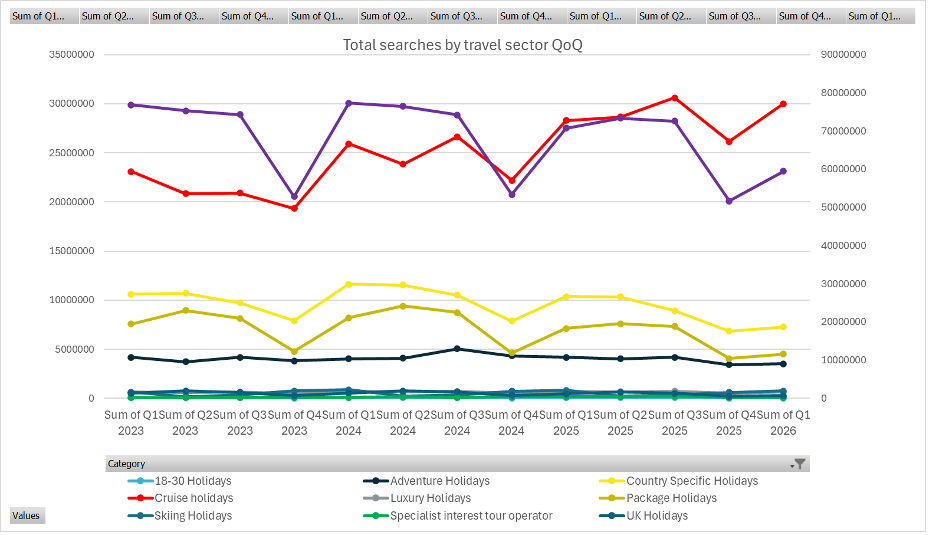
Whilst the raw numbers for cruise searches hit an all-time record in the first quarter of 2026, I also wanted to look at the comparative changes in each travel sector as sometimes things can get drowned out by raw numbers. As you can see in the graph above, several travel sectors struggled this quarter including package holidays, adventure holidays and also specific country searches.
This is best illustrated by looking at the percentage changes each type of travel quarter has seen over the last few years, which is shown below.
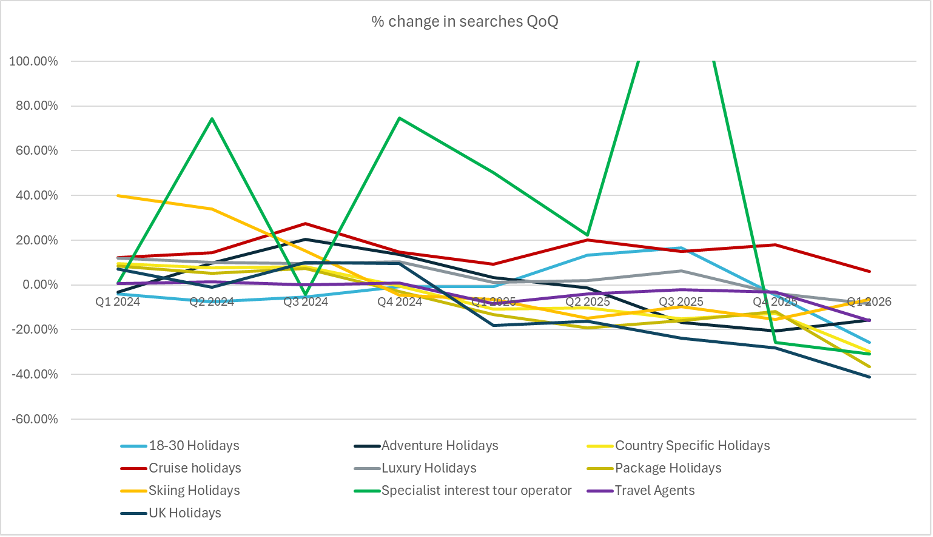
The graphs for most types of travel show some drop off in this quarter although some areas like UK holidays have seen that drop happen through last year compared to the peaks of 2024. One might expect with so much turmoil in the world that searches for holidays in the UK might’ve started to pick up in 2026, but the initial months don’t bare that out. With that said, Travel Weekly recently highlighted that Hoseasons had seen an uptick in demand this Easter Holidays. It’s a trend that we need to keep a close eye on as the Isreal/US war continues to play out.
Continent and country analysis
The continued wars in Isreal, Iran, Ukraine, Sudan and several other places surrounding these areas is horrible to watch from afar and our thoughts must always be with those that are affected by those people that live in and are connected to those countries. It will likely be many years until travel returns to any type of normal within those places.
The knock-on effect of these wars on travel is both direct and indirect, with many destinations off limits according to the Foreign Office. Some neighbouring countries remain unaffected yet continue to feel the impact due to a lack of traveller awareness and the assumption that they too are affected. It can be difficult to separate fact from perception, but when travel misinformation is on the increase online, it can make certain destinations less appealing when they are still 100% open for business.
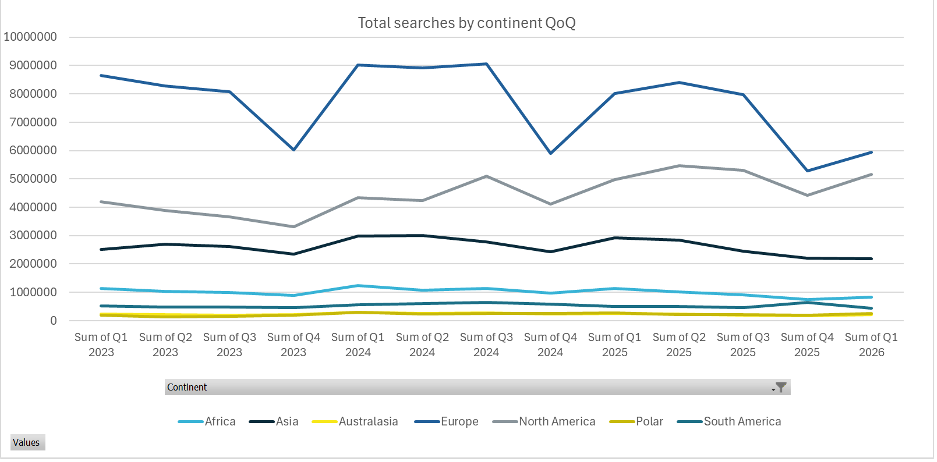
From a continental perspective, it’s not unsurprising given my general theme so far that searches for most continents are below where they were last year. With cruise still on the up, one of the most popular destinations on cruisers’ radars in 2026 is the Caribbean. With its mostly fantastic weather and relative calm away from the storm of global events, it’s continued to thrive and helped the North America searches beat the general trend.
For the top 10 countries visited by travellers from the UK, some of our perpetual favourites fell sharper than others as the general trends of newer destinations or ‘dupes’ continue to eat into the general market.
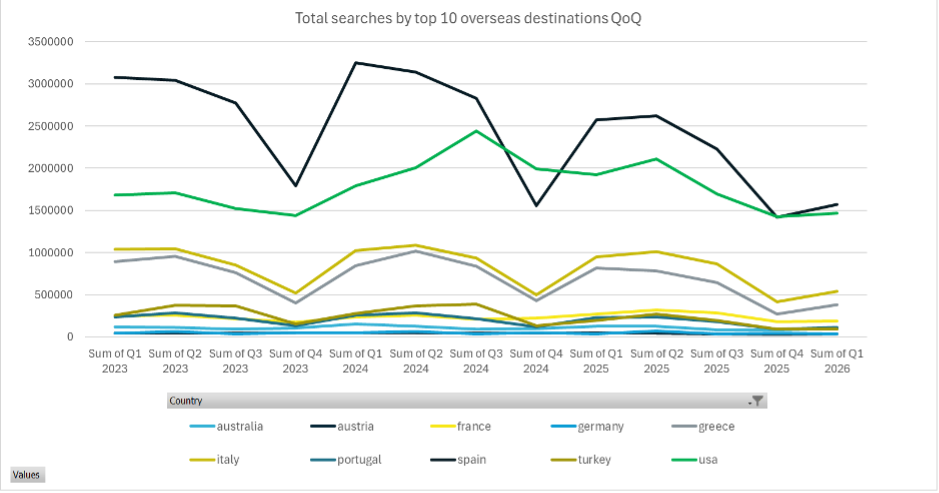
While some favourites are largely in line with recent past, seeing Spain have such a drop is a big surprise as it’s been an almost immovable destination at number one for UK travellers for decades.
Whether searches will recoverin the late market or not will be fascinating to watch. There will no doubt be plenty of discussion around late bookings this summer, once there is more clarity on the ongoing conflicts, the cost of travel and whether going abroad feels less appealing than a UK break for those planning a trip this year.
Similarly, the peaks seen in travel to the US last year (perhaps more closely linked to the World Cup than anything dear Donald has done) will be one to keep an eye on as the event comes and goes and the shine of brand US continues get tarnished.
Search analysis summary
It’s hard to know what to make of this quarter’s search results. I’ve been writing these updates for many years, and this is the sharpest change in numbers I can recall since Covid. While some sectors have always seen peaks and dips, this year it feels as though travellers are holding back more than usual.
There are many questions to be asked here…
Are holiday makers using Google less to search for travel in 2026?
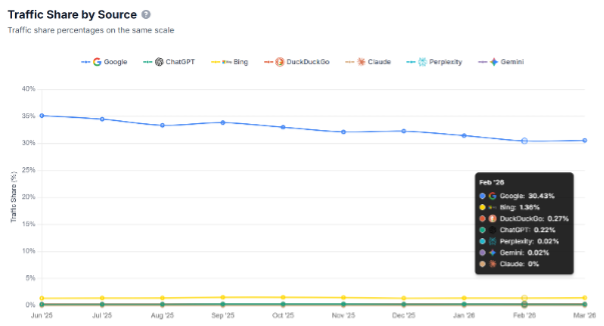
Perhaps so, according to data from Ahrefs on their great Google V ChatGPT tool which suggests searches have fallen over the past nine months by around 15%, which would actually line up with our data here (although, frustratingly, I can’t go back to Q1 2025..).
Are travellers typing in longer queries to search for holidays which aren’t picked up by the keyword tool?
Spoiler alert – it doesn’t look like it from our research. Our analysis carried out in early 2026 into travel searches and search length changes showed an increase in search length of 13.4%, hardly breaking the internet but certainly notable.
With that said, historical data in Google Ads supposedly shows exact match rather than broad match search volumes. I’m pretty sure this is total BS given how some searches jump around lots in their volumes month by month and how Google handles ‘exact match’ these days (just ask any PPC manager with any hair left).
Are people ‘all using AI now’ so searches are dropping?
The graph above would suggest that searches are perhaps moving somewhere but as the numbers of searches for ChatGPT are around 0.22% and less than 0.1% for Perplexity, Claude and Gemini, that would also appear not to be the case.
Are travellers just not searching as they can’t afford it right now and will book later?
Well reader, if I knew the answer to this, I’d be a very busy man in the coming months. But I don’t. No one does. However, it does seem that with late bookings happening in Easter and bigger agents like Hays seeing some ‘shoots of recovery’, it’s very likely that it’s going to be a very fluid and fragile time this summer.
What can I do about all of this?
Ultimately, the trends shown here are just indicators. Drops in search volume don’t necessarily mean disaster.
I know many travel companies who have had brilliant booking numbers in 2026 so far, while others have suffered. There’s no doubt that world events have caused big disruptions, and will continue to influence how and where (and if) we travel this year and next.
It’s worth focusing on your existing customer base and putting more effort into staying connected with them, reminding them you’re there to help. The cost of securing repeat bookings is far lower than acquiring new customers. Use your social media channels to remain visible and relevant, especially during uncertain periods.
And if things do start to become more settled (we can only hope) and confidence comes back, or if you just want to try and pick up those still active in the market, then paid media channels like PPC on Google, Bing and Meta can short cut your way to the audiences you want.
If you think we can help with any travel marketing challenges you’ve got, then drop us a line.


