I know, I know. It’s already three weeks into 2026 and yet I’ve only just written up some thoughts for the year ahead. ‘Shouldn’t you have done this a month ago Andy?’
Well, possibly. I have however, been busy PLUGGING THE HECK out of my book, ok? And fortunately for you I gave that a rest for an hour to work on some thoughts for the year ahead.
No doubt you’re already watching your daily lead and sales reports roll in and thinking about how to explain the numbers to your colleagues. You’re also peering into the next few weeks, quietly hoping the graph nudges a little further up and to the right. We all are.
But post peaks/wave is one of the busiest times of the year and we still have 11 months left to think about, work around and make the best of. In the world of digital marketing, it’s certainly going to be another interesting year. What will happen to the AI bubble? What will happen to travellers’ wants and needs when travelling? And what will happen to our marketing efforts?
Here are some areas that I think are worth considering to help your overall success in travel marketing in 2026.
1. More of the same
We have to face the facts that the general economic outlook across the UK and Western world is largely flat. Growth in the G7 or G20 (or whatever group of countries you want to look at) is, well, basically flat.
Despite making ‘growth’ one of the pillars of their election campaign, the Labour government hasn’t really achieved much, to put it bluntly. Growth forecasts may have edged up from around 1% to now perhaps 1.4% in the UK, but that’s still not the rate Ms Reeves would've been hoping for a few years back.
Additionally, there are still ongoing struggles with inflation which is still quite a way ahead of the Bank of England target of 2%, although it should start to come closer to that target as time goes on.
The outcome of all these factors is that 'real disposable income growth is likely to remain weak in coming quarters given wage growth moderation, elevated mortgage rates, and a larger fiscal drag on household incomes’, according to Goldman Sachs.
To expect our travellers to be able to splurge an extra 20% on their travels this year is perhaps fanciful but as ABTA has shown repeatedly over the last few years in their Travel Trends report, we WILL travel in 2026, even at the expense of other activities like eating out or buying new tech. Their report highlighted the top 15 destinations we’re planning to travel to in 2026 and, well, there is almost no change. The top 10 and their percentages have hardly budged since travel returned, so again, if you are expecting big changes in travellers to your destinations, I think you are sadly mistaken.
What to do?
Unless you’re targeting a small part of the market, such as a niche destination or a specific type of travel, say ultra-luxury or retreats in Asia, you should be planning for modest increases in booking volumes within your target market. That’s not to say double-figure growth isn’t possible, but assuming broadly similar marketing budgets, there’s unlikely to be any dramatic change in consumer buying habits at a macro level.
2. AI Mode and Ads
Perhaps the benefit of holding back a few weeks into the new year allows for a few more things to become clearer. At the end of 2025, Google started to show up ads in AI Mode which hadn’t really happened before. We knew they were going to come, but just when and how.
When you have to protect one of the biggest profit machines in the history of humanity, you can’t just bin it off overnight. Google never moves fast these days - they are too big and have too many investors.
But AI mode is starting to be pushed more aggressively. I’m not a Google user, yet I was surprised to see a ‘Use AI mode’ banner promoted to me. My assumption is that Google still wants wider adoption, more data, and more time to refine the ads product, given that AI mode usage through most of 2025 sat at around 5 to 10%, even though uptake did accelerate as the year went on.
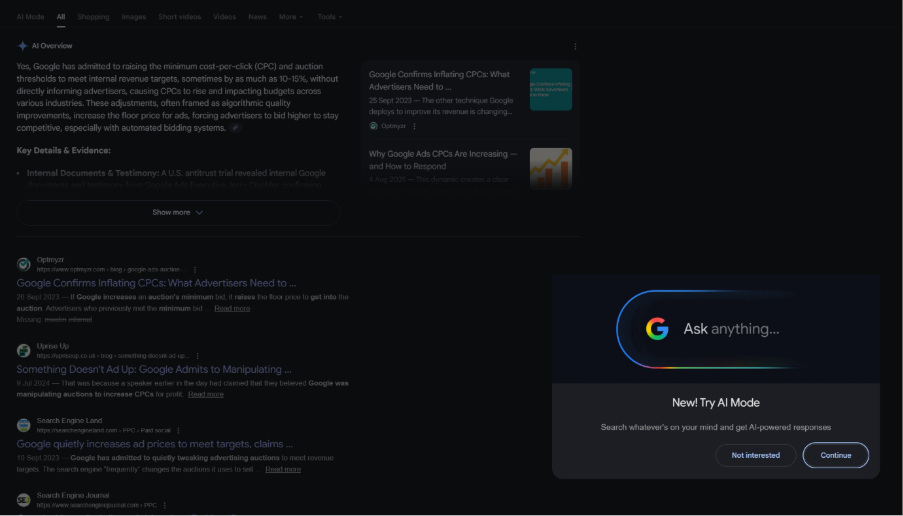
This year, advertisers will have to grapple with this rollout. Ads in AI Mode will be delivered through ‘AI Max’ campaigns, with ad reps and their tentacles in the bigger agencies, our advice is to hold off as long as you can, enthusiastically promoting case studies of ‘amazing ROI achieved for Fairy Liquid!’ or something similar.
I spoke about graphs going up to the right over time and I have no doubt that internally Google will be needing theirs to do the same. Where is the extra $10 billion going to come from this year when user growth is largely flat? That’s right – your marketing budget and mine. How? More erroneous bidding on a wider set of phrases that aren’t relevant to your destinations and trips, coupled with more arbitrary increases in CPCs or CPAs (if you prefer to bid that way).
We’ve seen with our own eyes that Google can and will push up CPC minimum bids more or less at will. When bidding is tied to exact phrases, which in an AI search prompt world are going to be anything but exact, understanding what you’re actually paying for becomes far harder, opening up a rather expensive can of worms.
Our approach is always one of cautiousness and control with Google Ads. We want to be as focused as we can for our clients and test new features when we need to. We’ve been burned far too many times by the Google beast to just push all our clients’ budgets fully into new areas (unless they work well – which they usually don’t) so will be holding back as much as we can.
There is, of course, another way AI Mode could play out, which is that over time, or for certain types of search, it simply doesn’t play much of a role at all. Alongside the AI hype, Google has also introduced a halfway house between old SERPs and AI chat in the form of web guide.
Older users may be less inclined to want or use AI. For some searches, it’s probably more helpful to organise answers into clear chunks rather than present a single plain list or a chat-style interface. This may be a personal bias, but I genuinely think the web guide interface has real legs as part of Google’s future. It aligns more neatly with existing ad units, feels more familiar to users with 10 or 20 years of Google usage behind them and, for certain queries, simply works better. My prediction is that by the end of 2026, web guide is part of the furniture and talked about far more than it is today.
What to do?
For anyone running PPC ads (and that will be nearly all travel businesses), understanding what the SERPs look like for your main phrases is really important. Know that Google is serious about AI Mode and will be pushing it hard this year. We’re going to have to play in this world, but in doing so, we are handing ever more control over to their machines to do our work. When we do that, we are going to have to expect more increases in spend over time.
Whilst some of the AI features might reduce acquisition costs in some cases, in the main, I expect them to push up CPAs and CPCs.
3. Bringing data into greater focus
Whilst we can try and be positive or sceptical about the state of play with Google Ads going forward, the reality is that for digital marketing to work effectively in 2026, there needs to be some sort of loop back from activity to outcome.
If a campaign is set up, it needs to somehow create signals back to Google (or Meta) to tell them what worked and what didn’t. Just because 100 leads were generated via a Pmax campaign, it doesn’t mean those leads were great or even worthwhile.
However, if some of them did convert into real value, we need to tell Google that. Failing to do so means the algorithms and AI will optimise towards the simplest signals, lead submissions or phone calls, which may result in no sales and no value creation at all. Feeding back identifiers such as a Google Click ID or a later-stage conversion value helps the machine optimise towards a genuine commercial outcome, rather than an arbitrary action like a form completion that carries little meaning until further qualification happens.
By prioritising data sharing with Google, Meta and other platforms, more information flows back into the system, improving performance and decision-making for marketing teams. Without this feedback loop, there is a significant risk of wasted spend. Despite that, many travel companies still fail to treat this as a technical priority worth fixing, leaving the door open for more proactive competitors to improve results and achieve stronger ROI over time.
Sadly, it seems that many travel companies are happier to waste £10,000 or more on Google Ads than fix internal challenges around data. It’s rather sad that this is the case in 2026 and I really hope travel businesses will see the value of quality data in time and that we are able to help them in this objective.
What to do?
If you don’t have any conversion data being passed back to Google or Meta, then you’re working with one hand tied behind your back - and it’ll cost you. Getting a data link between your CRM (ideally automatic) to push through successful conversions will pay for itself many times over in the years ahead if you’ve not already done it.
4. The attribution issue
Whilst it might seem potentially fanciful for travel businesses to feed back information around lead quality to the various marketing AI tools we use, I really hope that this makes progress with our clients in 2026. This is the first stepping stone to helping increase lead volumes in 2026 as well as creating a better view of how marketing is performing.
These basics can sometimes feel a long way off, but we do know many travel companies that have already moved beyond this narrow view of marketing performance. Last-click attribution, particularly where a PPC campaign takes all the credit, has been around for far too long, but there are signs that some businesses are finally starting to look past it. I genuinely hope that 2026 is the year we see real progress here.
We already have several clients exploring third-party, non-Google tools such as Steep, Stape and others to achieve more accurate attribution of marketing success. This only becomes more important as user journeys continue to fragment across channels and devices.
I’ve said on stage many times that I think we’re beyond ‘peak data’, in the sense that we’re unlikely to see as much detail as we once did for several years when it comes to how people arrive on our websites and what they do once they get there.
With AI discovery, cookie banners and general user privacy becoming more default, we’re going to know less and less about our visitors and how they found us. Therefore, it should be even more important to prioritise good data collection and then use it effectively to find competitive advantage. I do, however, expect that this will still be the exception rather than the norm and so most travel companies will rely on anecdotal or incomplete information to help power their businesses.
Even with less sophisticated data, there is a reality about what is achievable with the data that we can still get. As time goes on through 2026 and 2027, there will need to be an acceptance that for some travel companies, the best data you can get is about your customers directly and then try to recreate some of your main USPs in your messaging back to the market.
Whether someone then clicks on your advert, website or social post will be hard to quantity. We’re going to need to trust our internal marketing teams and agencies to ‘do the right thing’ without necessarily having the data or information that we had in the past to verify the results being achieved.
Thirty years ago, we relied far more on aggregated signals to judge whether our marketing was working. As 2026 unfolds, I think we’ll need to become more comfortable with that mindset again and focus on how we adapt to operating in that way.
What to do?
If you’ve not set up call tracking already when you receive calls, this needs to happen. If you’ve not set up other tracking linked to a CRM of some description to understand all the touch points you might have in a booking journey, this also needs to happen.
Travel companies still operating on a last-click basis are going to fall behind as 2026 progresses. Those with a stronger grasp of user journeys will optimise far more effectively than those relying on a single attribution point. If you haven’t invested in better user tracking yet, this is the year to do it.
5. From AI bubble to simmer
What else to expect in 2026? Well, the AI bubble that was blown in 2024 and 2025 can’t surely keep getting bigger, can it? If I knew the answer to this question, I don’t think I’d be spending my time pontificating here, dear reader. I’d be sat supping pina coladas all night and day.
But honestly, I don’t know. My track record of predicting declines for Apple, Tesla and others has been way off the mark many times. I am not a reflection of wider society. And dare I say it, I doubt you are too.
With that said, when tens, nay, hundreds of billions of dollars are spent year on year chasing an AI dream (of AGI), it does feel like at some point, Alphabet, Apple, Amazon, Meta and several others do need to say: ‘hang on a minute, perhaps we should slow down a bit’. Given recent trends this does seem unlikely. So perhaps it won’t be them having a word with each other, perhaps it’ll be the market doing it for them.
Maybe, and it really is a maybe, we’ll see a big tech investor or user, say Barclays, Adidas, Samsung or some other high-street name, sticking their neck out and proclaiming, ‘you know what, this AI stuff… nah, it’s not all that’. More likely, it could be a handful of smaller ones, one after another, deciding they’re done funding the AI dream and pulling back towards more traditional technologies instead.
I guess the idea of the AI bubble popping is more of a personal pipedream rather than something that is likely to happen. With that said, if we did start to see a deflation of AI investment or AI expectation, rather than an all-out pop, I wouldn’t be surprised at all. There does need to be some market correction. Whether it is 2026 or 2027 though, very much remains to be seen!
What to do?
This isn’t an easy one to answer! Do you go heavy on AI tech integration that might be out of date in 12 months? Or do you risk looking a complete fool in 18 months’ time? Right now, no one really knows but I’m sure as time goes on, things will become much clearer about how users are behaving and what they really value.
6. Existing customer focus
While many travel companies still focus heavily on acquiring new travellers, plenty recognise that this is an expensive game to play. The cost of acquiring a new customer is often quoted as being anywhere from five to fifteen times higher than retaining an existing one. Yet when we speak to new travel clients about their growth plans, the conversation is almost always centred on Google Ads or other paid channels, with barely a mention of existing customers. These are people who have already experienced your product, understand it better than almost anyone else and are, more often than not, overlooked.
Travel businesses that succeed in 2026 will put as much focus on existing customers as they do on winning new ones. Email, SMS and even direct mail will play a growing role for more mature travel companies looking to improve marketing effectiveness and drive higher margin or revenue as the year goes on.
What to do?
Realistically, focusing on existing customers is about being brave and going against the grain. As a travel marketer, it’s far easier to tell a board you’ll focus on Google Ads, Meta and perhaps email, TikTok or another familiar channel. These are things they’re likely to understand instinctively, even if they don’t always appreciate them within a broader strategic view.
Yet sharing a wider view of customer base and chance of success is something we need to do more of in 2026. We can’t just expect customers to convert as the same rate or same CPA as has happened in the last few years. The customer booking journey is getting longer, more fragmented and more complex as time goes on. Having a direct route to shortcut this should be on every good travel marketer’s roadmap.
And it it’s not, then you need to have a long hard think and work out a plan of how to get closer to your existing customers to get an extra increase in your lead and booking values.
Summary
Growing your travel booking numbers in 2026 isn’t going to be easy. Political and economic instability or at best, stagnation, isn’t going to make it easy at all. That, coupled with increasing pressure around AI and big tech is just going to increase the complexity of what was once seen as an ‘easy’ job in digital marketing (not that it ever was, by the way!).
We know that addressing some of the challenges outlined above takes time, expertise and the right support, and if you think we can help with any of this, we’re here to do exactly that.
If you plan to tackle these challenges in-house, all we can do is wish you the best of luck and hope you make solid progress along the way!


