There was a time when the most exciting travel update you could receive was a hard copy paper ticket arriving in the post. Remember those? Lovely little wallets, perhaps containing some complimentary branded luggage tags along with your printed tickets.
Now, of course, we want (and expect) everything digital and in real time: security queue times, gate info, boarding pass, transfer details, hotel check-in info and weather updates delivered straight to our phone. We also want instantaneous responses to problems encountered. Missed connections, flights cancelled, crocodile in the hotel room bidet.
We'd also prefer all this info in one neat and tidy app we recognise and can’t stop checking for an average of 16 hours per month.
Oh hello, WhatsApp. Were your ears burning?
With more than 3 billion users, WhatsApp has moved beyond simply being a way for family and friends to chat, and has expanded into a serious customer communication tool for travel brands.
So, should every travel brand be using it?
Well, perhaps. And also, perhaps not. (Helpful, I know).
Who’s already using WhatsApp in travel?
Airlines are probably the most obvious fit. Air France uses WhatsApp across marketing messages, customer service, flight updates, boarding passes and info such as which baggage conveyor belt to head for upon arrival. According to a WhatsApp Business case study, Air France exchanged more than 33 million WhatsApp messages with customers between April 2024 and April 2025.
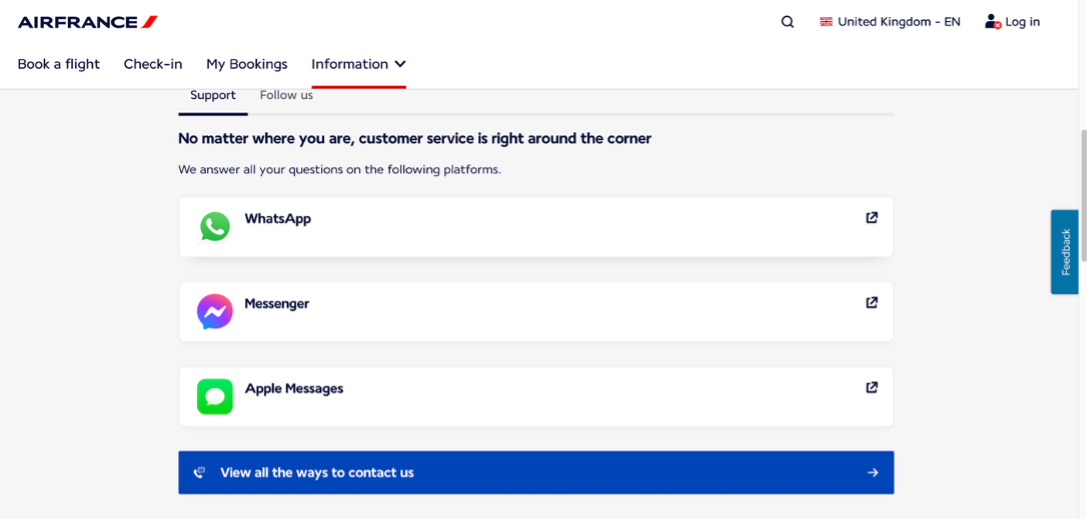
The airline also reported a 4.5x higher click-through rate for its best offer newsletter on WhatsApp compared with email, while 85% of its social customer care conversations happened on WhatsApp. Obviously, platform case study numbers should always be viewed with a little caution, but even so, those are not numbers to be sniffed at.
Other airlines using WhatsApp include KLM (who were the first airline with a verified account), Emirates, Qatar, Cathay Pacific and British Airways.
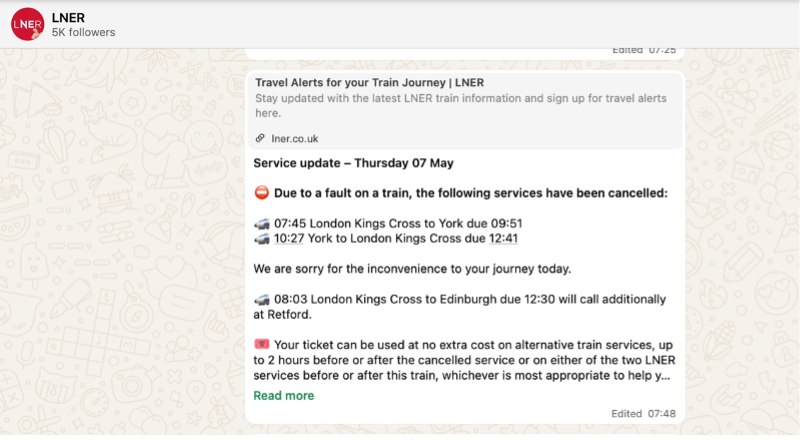
Rail is getting in on the act too. LNER launched a WhatsApp Channel in October 2025 to broadcast service updates, travel advice and disruption information. The channel, kept up to date directly by members of the LNER Service Delivery Team, provides customers with the opportunity to check if anything could affect their rail journey before they set off while also being a source of information during a disruptive incident affecting the railway.
Away from airlines, there are deal-led brands such as HolidayPirates, who has reported its WhatsApp Channel subscriber base grew eightfold to more than 625,000 after switching to Channels in March 2024. The company said more than 4% of its traffic now comes from the channel, with many clicks happening within minutes of sending a message.
Again, these are stats that travel marketers will find very hard to ignore.
Why WhatsApp makes sense for travel brands
Travel is an industry built on logistics, anticipation and occasional low-level panic.
Where’s my boarding pass? Am I in the right terminal? Is the transfer still coming? Where the hell is my train? Why is my suitcase in Johannesburg when I’m in Frankfurt? Am I in the right tour group?
For airlines, rail operators, OTAs, cruise lines, escorted tour operators and travel agents, WhatsApp can reduce inbound calls by answering the obvious questions before the customer has to ask them. ‘But isn’t that just what a chatbot does?’ I hear you cry. Well, yes. But somehow, WhatsApp feels decidedly more personal. It’s already on the traveller’s phone and is a little slice of familiarity when you might be stuck somewhere which is anything but.
The marketing upside
Used well, WhatsApp can keep leads engaged, send PDFs, images or itinerary snippets, answer quick questions and maintain the sense of personal service that many customers still value deeply.
But it’s not all sunlit uplands.
The downsides and risks of using WhatsApp
One of the biggest issues with WhatsApp is also its biggest strength. It’s personal.
People use the platform predominantly to talk to loved ones, friends, acquaintances and that one annoying group chat which should’ve been muted in 2023. A travel brand infiltrating that space must be useful, restrained and very clear on consent.
There are practical limitations too. LNER notes that notifications for WhatsApp Channels are turned off by default, meaning users have to choose to turn them on before travel. That’s good for the user, but less handy if your grand plan involves instant reach.
Then there’s the rather chunky issue of scale. WhatsApp is brilliant for starting conversations, but once a business has dozens or hundreds of chats flying around, things can get very messy very quickly without a structured support system behind them. Slow replies lose bookings, multiple agents using one number can lead to duplicate responses or missed messages, price-only enquiries can swallow huge amounts of time.
Finally – and this is perhaps the thorniest issue of all - there’s the data problem. Travel brands handle sensitive information, from passport details and payment queries to accessibility needs, medical notes and family arrangements. WhatsApp may be encrypted, but that doesn’t mean every conversation belongs there. Booking details, travel documents and payment flows still need proper systems, clear records and GDPR-safe processes. This is where it all becomes a bit of a risky business.
Back in January, SME Today highlighted concerns around using WhatsApp as a primary business communication platform, including cloud backups, phishing, third-party risks and the lack of controls for secure data storage, consent management and archiving. Those are not small issues for travel businesses handling personal customer information.
So the real danger isn’t using WhatsApp. It’s the fact a lot can go wrong if not managed and utilised properly.
What sort of travel businesses is WhatsApp right for?
Reading the above, you’d be forgiven for thinking this is a bit of a hatchet job on travel brands using WhatsApp, so it’s important to add I think it’s a great comm tool for businesses where timing, reassurance and personal contact matter.
Airlines, rail operators and ferry companies can use it for disruption and journey updates. Hotels can use it for pre-arrival info, room requests, check-in support and concierge-style messaging. Tour operators can send meeting points, weather updates, packing notes and day-by-day reminders.
Travel agents can use it to nurture enquiries and support customers before, during and after the trip. For a homeworking agent, it can be a brilliant relationship tool, as long as it doesn’t open the floodgates to every single customer query or gripe (what homeworking agent wants to hear their phone ping at 3am because a client’s locked themselves out of their hotel room?).
It’s also a natural fit for markets where WhatsApp is already the default way people contact businesses. PhocusWire reports that in parts of Asia, including Malaysia, Indonesia, Singapore and Hong Kong, messaging hotels, tour operators and hosts on WhatsApp is already normal behaviour.
Blessing or a curse?
WhatsApp can be a blessing when it makes travel easier. Used for timely updates, practical support and relevant recommendations, it can reduce friction and make customers feel genuinely looked after.
It becomes a curse when brands don’t keep a tight enough rein on activities. The more personal the platform, the less tolerant travellers become of irrelevant messages, slow replies, clunky automation or poor handling of sensitive information. Without the right systems, boundaries and support behind it, what begins as a helpful customer service tool can quickly become intrusive, operationally chaotic and vulnerable to data misuse.
As ever, jumping on a trend just because others are doing it is rarely wise (see also AI). The question that needs to be asked is whether WhatsApp can help your brand be more useful, more responsive and more reassuring.
If it can, brilliant. Crack on.
If it can’t, leave the traveller’s family group chat energy alone and stick to your tried-and-tested channels.


