The dust has now settled on what was perhaps one of the most turbulent summers for the travel sector in recent memory. With the war in the Middle East dragging on, extreme heatwaves across Europe, fuel price surges and plenty of other uncertainty, significant numbers of travellers held off making decisions until the last minute.
Our latest analysis of Google travel search trends reflects some of this uncertainty, with demand falling across most categories in Q3. But dig a little deeper into the figures and there are some interesting differences between destinations and holiday types.
Headline stats
Let’s get straight into the numbers
- Q3 2026 saw another drop in search demand across almost all travel categories, down 12.32% compared to the same period last year. This continues a trend seen throughout 2026 so far, with each quarter recording a year-on-year decline of around 12%.
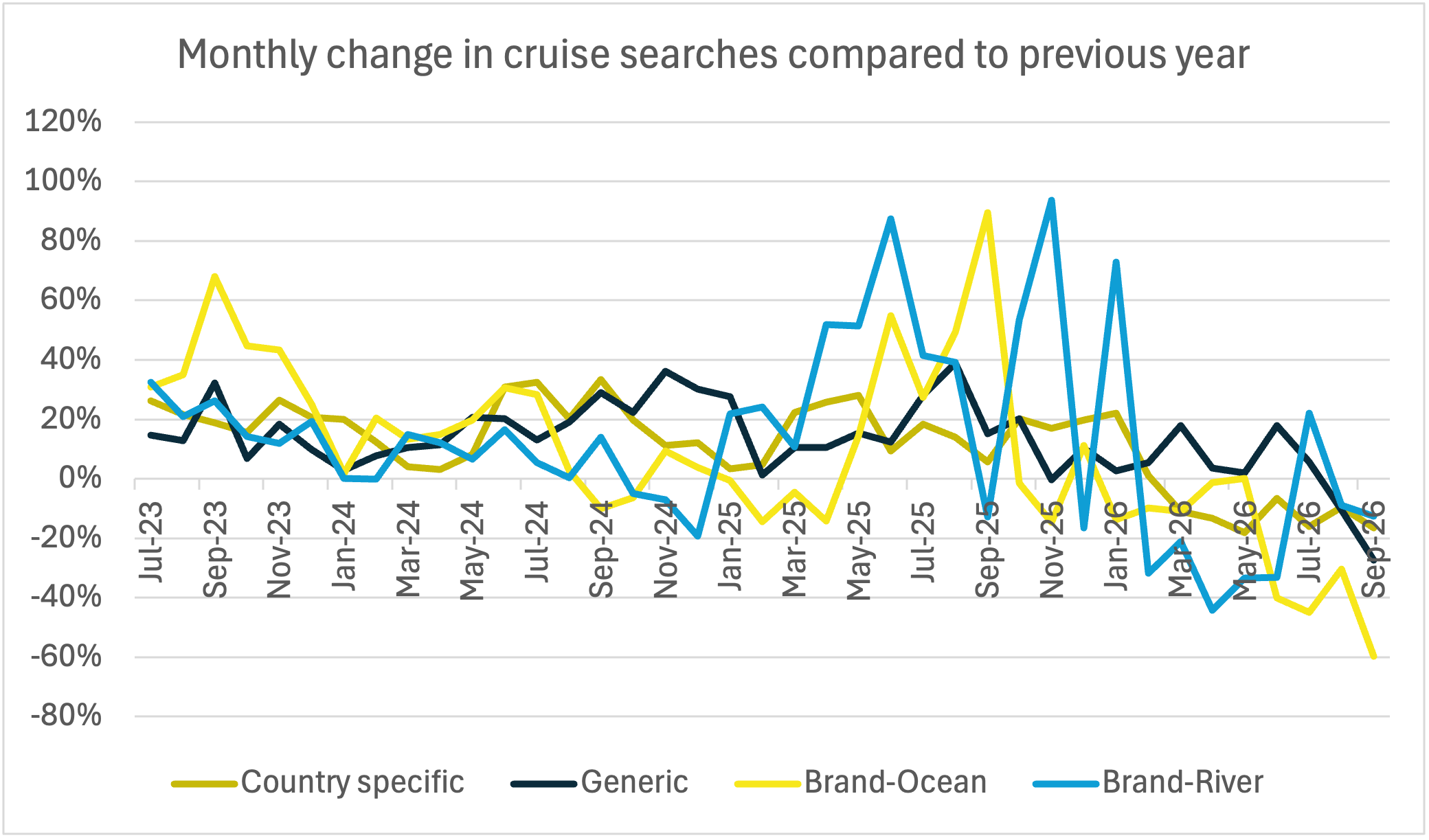
- Searches for UK holidays came closest to bucking the trend, with a marginal drop of just 0.53% in Q3 2026 compared to the same period last year. Meanwhile, 18–30 themed holiday searches and specialist interest holidays saw large declines of 43% and 41% respectively. Even the seemingly unstoppable cruise sector saw demand fall by 15%, although with river cruising hitting the headlines for all the wrong reasons, perhaps that's not much of a surprise.
- Searches for North America dropped a whopping 47% year on year, perhaps due to the ending of the World Cup whereas the year before would’ve picked up the people booking a year ahead. Or perhaps it’s just that US tourism is struggling overall with many travel publishers noting a 10% overall drop in demand due to… well, I think we know.
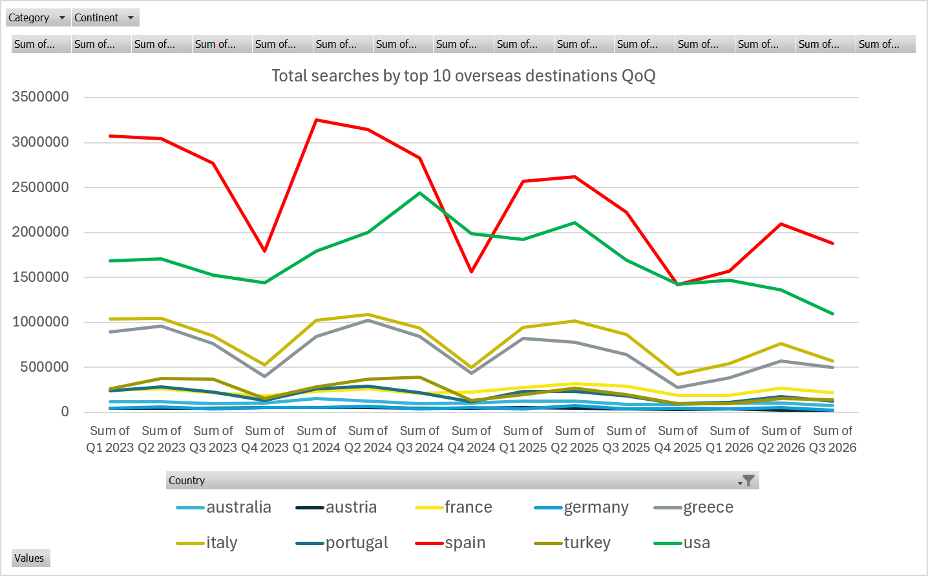
- Our top ten destinations for UK travellers all saw drops in search demand, with Spain performing best despite a 16% year-on-year decline. TTG highlighted that Spain attracted a lot of travellers this summer as world events prompted many to change their travel plans, and our data appears to reflect this.
- Anecdotally, I've also heard that Italy and Greece enjoyed good summers, yet both saw larger drops in search demand than Spain. It makes me wonder if bigger travel brands like Jet2 and TUI are getting better at retaining customers, with search demand falling even as sales continue to grow slightly. Only they really know, I guess.
The chart below puts these figures into perspective, showing how search demand for the top ten overseas destinations has changed over the past few years. Spain continues to dominate in terms of search volume, but the wider decline in demand is clear.
Caveat time!
At this point, I have to question whether travel searches really are down or if Google has changed how it shares data through its Keyword Planner tool. With more than 1,000 search phrases in our dataset and very few showing any growth, I can't help wondering if there's more to these figures than meets the eye.
To see travel searches consistently down by around 10% throughout 2026 seems odd, particularly as Google hasn't reported a decline in overall search activity (and travel numbers appear to be broadly flat in 2026 too). In fact, Google has said that 2025 saw more searches than ever before. Did 10% of users leave in 2026 overnight? Have AI Overviews stopped people searching as much? Are users ditching Google as their primary search tool and are now defaulting to their LLM of choice?
Perhaps some or all of these factors are playing a part, but the consistency of the decline since January 2026 still seems strange, given that these changes have been happening gradually over several years.
Whatever the explanation, it's worth remembering that our data is more useful for identifying trends than providing definitive search volumes.
Biggest country search growth
With so few search terms growing in 2026, it should come as no surprise that only a few countries made positive gains in Q3 this year (only 10% of our country list did). What is most surprising though is that Albania gets into our list again for the first time in over a year or so. Albania was the talk of the travel world in 2024, but in 2025 it seemed to settle down to a ‘normal’ level of searches.
Between July and September 2026, however, both Albania and Montenegro, another so-called ‘dupe destination’, saw growth in travel searches, which was encouraging to see.
I've heard plenty of discussion about investment in tourism infrastructure in both countries, while increased flight routes to Albania also came up in a recent episode of our Let's Talk Travel podcast with Claire Brighton from ATAS.
Country |
Total |
YoY search change |
United Arab Emirates |
51800 |
21% |
Montenegro |
100700 |
18% |
Panama |
101830 |
16% |
China |
140200 |
13% |
Albania |
175110 |
12% |
It was also surprising to see searches for the UAE bounce back, given the ongoing instability in the region, so we'll be keeping a close eye on that. Meanwhile, China's continued growth is hard to ignore, helped by positive changes to its visa system in recent years.
Biggest country search losses
As already mentioned, searches for North America took a huge plunge this quarter, potentially due to the boost from World Cup-related searches a year ago and a wider decline in US tourism.
The Bahamas, which has performed well in recent years thanks to strong interest in ocean cruising, was also hit hard by Royal Caribbean's decision to cancel a number of sailings in spring 2026 and reduce its routes in the region. With nearly all our Bahamas search volumes linked to cruises, the sharp decline is perhaps understandable. We may see demand recover in 2027 if more itineraries go on sale.
Country |
Total |
YoY search change |
Portugal |
121710 |
-34% |
Italy |
569980 |
-34% |
USA |
1097420 |
-35% |
Cabo Verde |
94700 |
-48% |
Bahamas |
71540 |
-66% |
What was the impact of the river drought on search demand?
Sadly, large parts of Europe ran dry during what was the hottest summer on record for many countries. This left river cruise lines having to juggle changing itineraries for passengers, while also losing existing bookings and missing out on the last-minute sales they might normally have expected. As someone rather bluntly put it on the TTC Travelcast in September, ‘The river cruise was on its arse’ over the summer months.
Interestingly, our data suggests the disruption had very little immediate impact on search demand. River cruise brand and generic searches were almost identical to summer 2025 levels, with declines of just 0.5% in July and 1% in August. The only significant drop came in September, when searches fell by 30%.
What was particularly surprising was that major ocean cruise brands saw some of the biggest declines in Q3. Given that river cruising was making headlines for all the wrong reasons, this seems rather odd. It does make me wonder, once again, if there's something going on with the underlying data Google is providing.
Of course, it's worth remembering that searches are a leading indicator of interest and intent, and don't necessarily translate into bookings during the same period. Ocean cruise bookings may well have remained as strong as ever, even as river cruise operators experienced the significant downturn already discussed.
Final thoughts
Whether the numbers Google is providing in 2026 are as reliable as they were in previous years is something I'm not sure I'll ever know. They've been messing about with plenty of data this year, including ‘poisoning’ search engine rankings recently to interfere with the data collected by SEO tools. A move that a seven-year-old would be proud of.
Google seems increasingly determined to pull up the drawbridge on data transparency, and I have a suspicion this could be another example of that.
That said, much of what we're seeing still tallies with wider travel industry reporting. Falling demand for the USA and continued interest in Albania, for example, suggest there's still plenty we can learn from these search trends.
World events continue to have a significant impact on travel demand, while travellers' tastes, budgets and available options are changing too. I expect we'll see further growth in so-called ‘dupe destinations’ over the next 12 months, alongside changes in the types of holidays people are searching for.
Certainly, Albania's strong performance this year shouldn't have come as a complete surprise. Our analysis was already picking up growing interest a few years ago. And if destinations such as Bosnia and Montenegro continue to attract attention, we could see them following a similar path.
For all the question marks hanging over Google's data, that's why I still believe this analysis has value. The exact numbers might be open to debate, but the emerging trends can give us an early indication of where travellers are looking next.


