Spend enough time online and you might start to believe that half the world’s airports are closed, airlines refuse to refund anything and most countries have sneakily introduced new visa requirements overnight.
This isn’t the truth of course, yet in an online environment where posts, images and videos can be created or manipulated in seconds, separating fact from fiction is becoming more of a challenge.
If you’ve been glued to The Capture, you’ll know how unsettling deepfakes can be. In this BBC drama series, surveillance footage is altered so convincingly that even investigators struggle to prove what really happened. Yes, this is just a TV programme, but the underlying issue is very real across a variety of industries - and that includes travel.
When misinformation starts to spread like wildfire, travellers need somewhere reliable to turn. Increasingly, that place needs to be the travel company itself.
Why travel is especially vulnerable to misinformation
Travel has always relied on accurate information. Entry rules, visas, flight schedules, cancellations, safety advice, vaccinations – getting the right info at the right time is essential for travellers.
Depressingly, that imperative makes the sector particularly vulnerable to misinformation.
Firstly, the goalposts are changing all the time. During Covid, rules chopped and changed almost daily, but even today entry requirements, airline policies and disruption guidance can be misunderstood or misrepresented within minutes online.
Secondly, travel is all too often a deeply personal investment. People want to believe the deal they’ve found is genuine or the destination they’ve spotted on social media is exactly as advertised. Sophisticated technology is making it easier to create convincing fake booking sites and emails that appear legitimate at first glance. AI is developing faster than our ability to spot it, and recent events suggest the same may be true of how the industry deploys it.
During the latest Middle East disruption, several airlines that had invested heavily in AI customer service tools appeared to scale back their use in practice, directing travellers instead to human agents and manual processes when demand surged.
Thirdly, travellers are seeking out information from an increasingly wide range of sources. TikTok, YouTube and Instagram are often the go-to for many, but a thirty-second video on these platforms explaining visa rules may not always be the most reliable source of immigration advice, even if it has thousands of likes and shares.
Put all of this together and you have the perfect conditions for misinformation to spread quickly. In some cases that misinformation spreads organically. In others, it is deliberately amplified by fake reviews, automated accounts and coordinated bot activity.
Fake reviews are becoming harder to spot
Another thorn in the industry’s side is the rise of fake reviews.
Online testimonials can make or break a brand. Hotels, tour operators and attractions are often judged within seconds based on star ratings and recent feedback. A handful of positive or negative reviews can significantly influence booking decisions.
The problem is that those reviews are not always genuine. A 2023 Guardian report into fake reviews found that AI can now generate convincing reviews for hotels, restaurants and products in seconds. With only a few prompts, AI tools are able to produce detailed hotel reviews complete with star ratings and formatted text that closely resembles genuine review platforms like Tripadvisor.
These platforms are trying to fight back, removing millions of suspicious reviews each year. Trustpilot for example removed 4.5 million fake reviews in 2024, while Google has ramped up its efforts to crack down on fake reviews for UK businesses.
In some extreme cases, the manipulation has reached mind-blowing proportions. You might remember a news story a few years back where a journalist managed to make a restaurant called The Shed at Dulwich the top ranked restaurant in London on TripAdvisor purely through coordinated fake reviews. The twist? The restaurant never actually existed.
Reviews are enormously valuable for credibility and search visibility. But they also create yet another platform where misinformation about a business can spread quickly, whether through fake praise, coordinated negative reviews or AI generated content.
Recent examples show how quickly misinformation spreads
It’s tempting to assume most people are now too savvy to believe misleading travel stories online. Unfortunately, that isn’t always the case.
Take what’s currently happening over in the Middle East. Misinformation quickly spread online about who was responsible for assisting travellers when flights to places like Dubai and Abu Dhabi were cancelled. Some posts suggested tour operators were responsible for providing accommodation and meals when in reality those obligations sit with the airline. As highlighted in this Travel Weekly report on the crisis, those rumours create extra pressure for travel companies already working around the clock to deal with disruption, forcing them to spend time correcting the narrative as well.
Recent reporting from Skift’s The Daily newsletter shows just how quickly confusion escalates when information is fragmented or inconsistent. Following US-Israeli strikes on Iran in late February, widespread airspace closures affected an estimated five million passengers across the Middle East.
As flights were cancelled or rerouted, travellers were faced with sharply rising fares, conflicting airline policies and long delays in customer support. Some passengers reported being told flights were cancelled, only to later find them operating at significantly higher prices. Others found themselves caught between airlines and online travel agents, unsure who was responsible for rebooking or refunds.
In the absence of clear, timely communication, travellers began organising their own information networks through WhatsApp groups and social media, sharing updates on routes, availability and alternative options. It's a stark example of what happens when reliable information is not readily accessible from official sources, as highlighted in Skift’s reporting.
But misinformation doesn’t always spread organically. In some cases, it's deliberately amplified by automated accounts and malicious bots designed to mimic genuine users.
The travel industry is a particular target. Research cited in Travel Weekly shows that more than two-fifths of traffic to travel websites now comes from malicious bots. These bots scrape fare data, attempt to access loyalty accounts and even manipulate availability through tactics such as ‘seat spinning’, where seats are temporarily reserved without any intention of completing a booking.
The knock-on effect is not just technical. Automated traffic can distort demand signals, inflate search data and create confusion for travellers when availability suddenly appears to change.
We have seen how quickly automated activity can shape online narratives in other industries. A recent analysis of the backlash surrounding a rebrand by US restaurant chain Cracker Barrel found that 44.5% of posts about the controversy in its first 24 hours were likely created by bots. The posts gained traction rapidly, resulting in media outlets picking up the story and the controversy quickly escalated. The result? A 10% drop in share price. Whilst the price did pick up again, it highlights the real world impact from online falsehoods.
For travel brands, the point is that misinformation doesn’t always stay confined to social media. Once misleading narratives are peddled out, they quickly spill over into customer service channels, call centres and booking behaviour. What begins as online noise can very quickly become a real operational headache.
What travel brands can do
While misinformation is unlikely to disappear, there are practical steps travel brands can take to protect themselves and respond effectively when it rears its ugly head.
1. Monitor the conversation
The first step is awareness. A lot of ‘fake news’ gains traction not because it’s particularly convincing, but because no one corrects it quickly enough.
Setting up Google Alerts for brand names, key destinations and principal figures within the brand can help identify stories as soon as they begin to circulate. Social listening tools like Talkwalker, Alertmouse or Brandwatch can highlight sudden spikes in mentions or unusual sentiment changes.
It’s also worth monitoring places where travel conversations often start, such as Reddit, travel forums and Youtube.
It’s not about leaping on every single comment but ensuring you’re aware of emerging narratives before they become mainstream.
2. Use your own channels to set the record straight
When misinformation does appear, time is of the essence. Travel companies already have a number of communication channels that can cut through the noise and help control the narrative.
A clear update on the homepage can provide immediate reassurance to travellers searching for information, as per this pop-up message currently on the Emirates homepage.
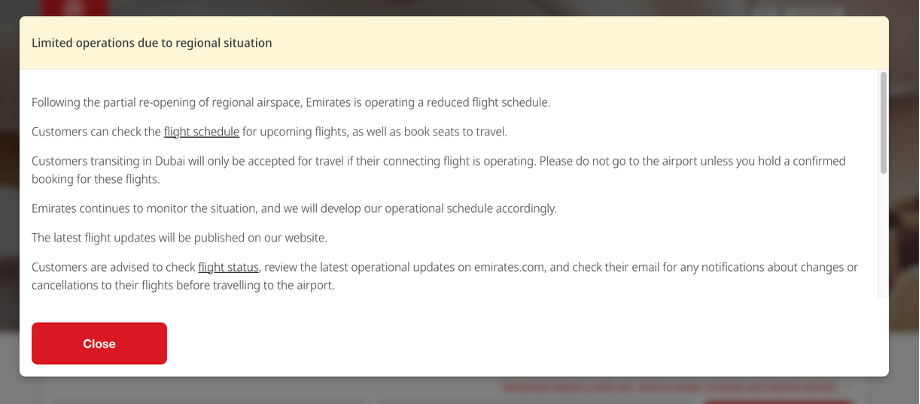
Text messages can be particularly useful during disruption when travellers need timely information. While on social media, a clear up to date post addressing misinformation directly can prevent speculation spreading further.
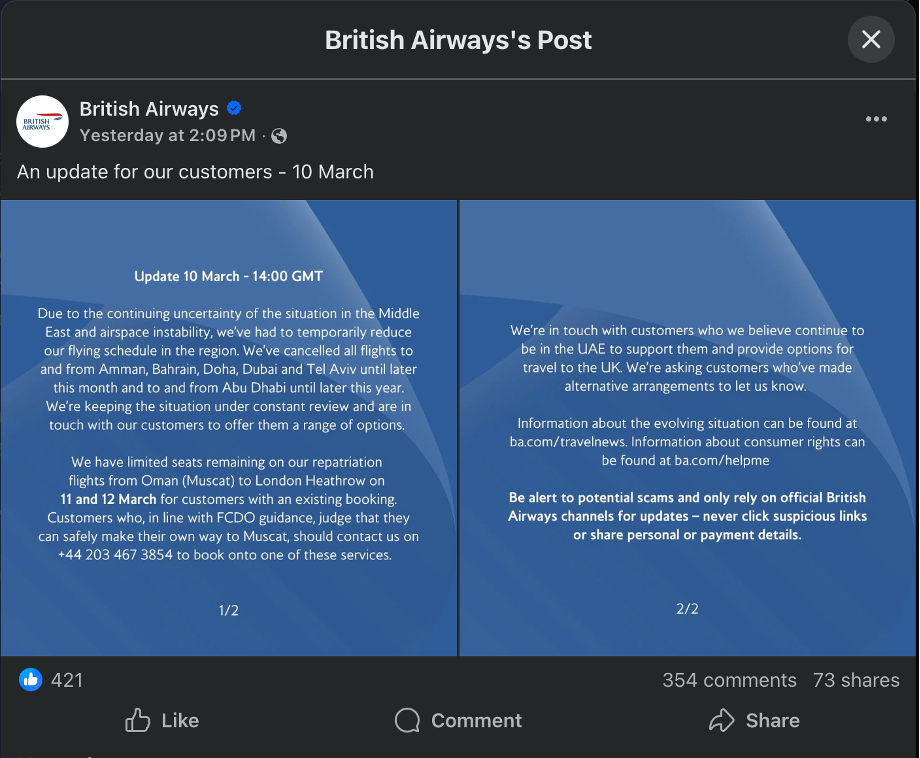
In short, the most effective response to misinformation is often simply providing accurate information quickly and in real-time.
3. Build credibility before you need it
Perhaps the most important point is that trust can't be built overnight.
If a brand only communicates clearly during a crisis, it's unlikely to suddenly become the most trusted voice in the room.
Travel companies that consistently provide useful, transparent information about destinations, policies and disruptions gradually build credibility over time. When confusion inevitably appears online, travellers are far more likely to check those trusted sources first.
Credibility also comes from engaging with feedback. Responding to comments and reviews on platforms such as Google, Feefo or Trustpilot shows that a brand is listening and willing to address concerns openly. It also signals to potential customers that feedback is taken seriously and not ignored.
Handled well, even negative reviews can reinforce trust by demonstrating transparency and a willingness to resolve issues.
Final thoughts
The internet has mostly been a blessing for the travel industry but it has also been somewhat of a curse, particularly when it comes to the speed and scale at which misinformation can now spread.
For travel brands, that creates both risk and opportunity. When travellers are unsure what to believe, they will seek out sources they trust. The companies that communicate clearly, respond quickly and remain transparent will naturally become those sources.
And in a world where rumours can travel faster than travellers themselves, that trust may turn out to be one of the most valuable assets a brand can build.


