Last week, I posted a little rant about an email I’d received which had clearly gone to quite a lot of effort to be personalised.
If you didn’t see the post, here it is:
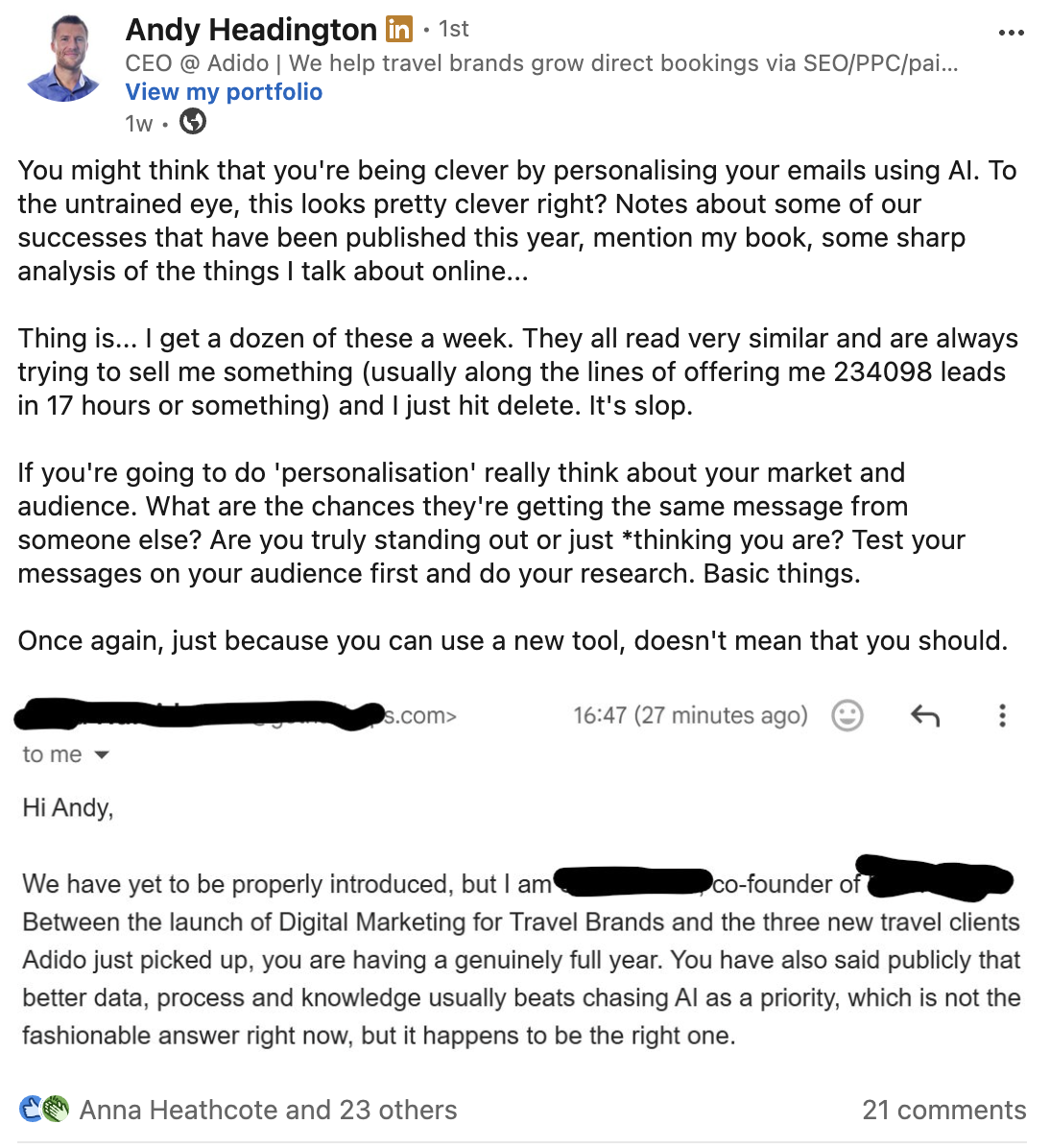
On paper, you’d probably give whoever built the personalisation workflow for this email a decent pat on the back.
Except…it was rubbish.
The whole thing felt forced and generated. There were little nuggets of information about me scattered through the email, yet nothing about it suggested that the sender actually understood who I was or why I might be interested in what they were selling.
And judging by some of the comments on the post, I’m far from the only one receiving this nonsense.
We’ve been talking about personalisation in travel marketing for years and AI is giving us the ability to take it much, much further. There’s a huge opportunity here. But if we aren’t careful, there’s an equally big opportunity to irritate people at scale.
So where does useful personalisation end and the creepy, irrelevant or just plain weird stuff begin?
We know travellers want personalisation
There’s no great argument from me on whether personalisation has a place in travel - of course it does. Travel itself is personal and more often than not, an emotional purchase.
A family looking for two weeks in Spain during the school holidays has very different needs from a couple looking for a three-night city break in October. A retired couple with plenty of time on their hands may approach a long-haul trip very differently from someone trying to squeeze Japan into their annual leave.
That gives travel marketers a lot to work with.
A report from McKinsey found that 71% of consumers expect companies to deliver personalised interactions, while 76% become frustrated when that doesn’t happen. In its 2025 Travel Trends report, Forbes also flagged just how important hyper-personalisation has become, particularly at the more expensive end of the market where customers increasingly expect experiences and recommendations to reflect their individual preferences.
So there’s clearly an appetite for relevance and nuance.
Where I think we need to be careful is in assuming that more personalisation automatically produces better marketing - because it really doesn’t.
When the data is right but the message is wrong
Imagine somebody spends a week looking at your Italy holidays. Your system logs it. They’ve viewed Tuscany, Rome and a couple of pages about Sicily. Maybe they’ve even started an enquiry. PERSON INTERESTED IN ITALY, screams the database.
So the emails start…
Top ten reasons to visit Italy.
Our favourite villas in Italy.
Why you should visit Sicily this summer.
There’s one small problem…they already booked Italy three days ago.
Maybe they booked with you and your email platform hasn’t caught up. Perhaps they booked elsewhere. Either way, the personalisation that initially looked quite clever now looks somewhat redundant.
Here’s a good example from New Digital Age. One writer returned from a weekend in Edinburgh and continued to receive recommendations from the booking company telling her to visit Edinburgh. And when it wasn’t sending emails about Edinburgh, it was recommending London instead.
The writer’s home city.
Cracking stuff.
AI can help…but it can also produce an awful lot of slop
I’m not against AI (well, perhaps a bit). There are some incredibly useful applications for it and I suspect we’re still somewhere near the beginning of what’s possible. Personalisation is one of those areas.
AI can help marketers spot patterns in customer data, group people based on behaviour and decide which message might be most relevant at a particular point in the booking journey.
It can also generate variations of those messages at a speed that would have seemed ridiculous a few years ago. But this is where I think some caution is needed.
The email that prompted my original LinkedIn post had technically done its homework. It had found information about me and inserted it into the message.
But why?
The details didn’t make the offer more relevant. They mainly demonstrated that the sender, or their AI, had been able to find them. The email itself just sounded, well, like AI slop. Kind of defeating the purpose of shoehorning in those little personalised titbits.
I had another one recently which tried to be clever but ended up looking ridiculous.
.png)
The sender was pitching an AI agent that could automatically find, qualify and contact potential clients for Adido. Standard AI cold emailing. Except it ended by asking whether they should be speaking to ‘Claire Malins’ instead. Smart move getting another name in there….or it would be, if anybody called Claire Malins had ever actually worked at Adido.
And don’t get me started on ‘LMK’.
When personalisation borders on creepy
We should probably talk about this one too as I know most of us have had that unsettling feeling that a brand knows a little more about us than we’d like.
Where you’ve been. Who you travelled with. Which airport you tend to use. Roughly how much you spend. Which destinations you’ve been researching. How frequently you travel.
Join enough data sources together and you can build a pretty detailed picture.
Some of that can make marketing genuinely better.
If I always fly from Bournemouth, showing me Bournemouth departures first makes sense. If I’ve already booked a summer holiday, stop showing me ads for the same trip. If I’ve travelled with you before, acknowledging that in a relevant email seems perfectly reasonable.
Problems start when a customer opens something and thinks, hang on, how do they know that?
Taken too far, personalisation can damage trust when customers discover that a company knows something they weren’t aware it had collected.
Post-holiday personalisation matters too
A lot of travel personalisation understandably concentrates on clinching the booking. But the weeks and months after somebody returns are arguably just as important. Unfortunately, this is where some of the laziest personalisation seems to appear.
You spent £10,000 on a honeymoon in Mauritius, therefore you must want to spend £10,000 on a honeymoon in Mauritius again. Or you went on a ‘once in a lifetime trip around Asia’, so naturally you’ll be planning another once in a lifetime trip around Asia next year.
Past booking behaviour is useful evidence, but it really shouldn’t be considered a permanent identity. Post-trip marketing needs a little more curiosity built into it.
Rather than endlessly recycling the previous booking, there’s an opportunity to use what you know as a starting point. Perhaps someone who loved a particular style of hotel would respond well to something similar somewhere completely different. Maybe their previous trip tells you more about the experience they enjoy than the destination itself.
That requires a bit more savvy thinking than simply slotting the last destination into an email template.
Perhaps personalise less, but do it better
For me, there’s a fairly straightforward way to think about all of this.
What does the customer get from it?
There’s a temptation with new technology to look at everything it allows us to do and work out how quickly we can do all of it. But as the old adage goes, just because we can do all of it, doesn’t necessarily mean we should.
I’d be more selective with personalisation.
Start with the points before and after a trip where knowing something about the customer genuinely makes the marketing more useful.
Make sure the information is recent enough to trust. Think about what behaviour actually tells you. Check that one system knows when another system has recorded a booking.
And once AI starts producing thousands of different versions of your emails, ads or website messages, please - and I cannot stress this enough - have somebody keep an eye on what comes out the other end.
You don’t need to demonstrate the full extent of what you know about somebody every time you communicate with them – this is at best unnecessary and at worst creepy.
People care whether what you send them is any good.
The best personalisation is probably the stuff people barely register as personalisation at all. Fewer irrelevant emails. Better recommendations. Ads disappearing once they’ve booked. Something interesting appearing in their inbox after they get home.
And if your amazing AI personalisation engine has discovered that somebody has just returned from New Zealand? Maybe don’t immediately suggest New Zealand.
Your customers don’t need you to know everything about them. They just need you to get the basics right. I think Claire Malins would probably agree…if we could find her.


