There’s something deeply infuriating about watching a competitor appear above you on Google, crop up in every travel feature and somehow seem to be everywhere your target audience is looking.
The instinctive response is usually to copy what they’re doing. Bid on their brand name, chase the same backlinks, write about the same destinations, spend more on paid media, etc…etc.
Some of that can work, but before you start throwing money at the problem, it’s worth taking a step back and asking yourself: why are travellers choosing them over you?
The answer might have very little to do with how much they’re spending on marketing. They may rank better, but they may also have a clearer proposition, a better website, stronger reviews or a much easier enquiry process. Their product might simply be a better fit for that traveller.
Winning more customers from competitors starts with understanding why they’re beating you, where they’re beating you and which battles are actually worth fighting.
Start with the target audience worth competing for
Competitor analysis often starts in completely the wrong place.
A rival travel brand ranks above you for a huge travel keyword, so you decide you need that keyword too. But if they specialise in mass-market £799 beach packages and your average booking is a £10,000 tailor-made trip, their traffic may be almost useless to you.
The same applies to paid media, social and PR. A competitor can have more followers, more visibility and more website traffic without attracting the sort of traveller who makes commercial sense for your business.
Before looking at what they rank for, where they advertise or which publications link to them, review your own numbers first. Which customers are most profitable? Which destinations or trip types give you the strongest margins? Who comes back and books again? Which enquiries turn into bookings and which audiences cost a fortune to acquire without producing much in return?
Once you know that, competitor analysis becomes a lot more useful. You can concentrate on the travellers you’d definitely like to win and understand why they’re currently choosing somebody else.
What if they’re getting found and you’re not?
Picture this: your competitor ranks for the same destinations you sell, their ads appear every time somebody searches and their name crops up in travel features and recommendation lists.
Yours doesn’t.
It’s painful, but it gives you somewhere concrete to start. Look at the organic keywords bringing them traffic, the pages generating that visibility and the sites linking to them. Check the paid search terms they’re competing on and where they seem to have built a stronger presence than you.
But this doesn’t mean you should treat their strategy like a shopping list.
Imagine you’re a Greece specialist and a competitor is consistently ranking for ‘Greece family holidays’ while you are nowhere to be seen. The obvious response is to create a family holidays page and go after the same keyword.
That might be the right move, but first look at what the search gap is actually telling you.
Is there meaningful demand? Do you already sell enough family trips to justify a stronger page? Do you have itineraries that genuinely suit them, or would the product itself need work before the marketing catches up?
If your competitor has built more prominent visibility around family holidays in Greece and your own enquiry data suggests there’s demand there too, you may have uncovered more than an SEO opportunity. You may have found a part of the market you’ve been under-serving.
The same logic applies elsewhere. A competitor ranking well for honeymoon itineraries, rail holidays or small-group tours may be telling you something about traveller demand, product gaps or how well you’re explaining what you already sell.
Sometimes the answer is better SEO. Sometimes it’s a stronger landing page.
Sometimes the uncomfortable answer is that the competitor has a clearer product for that traveller than you do.
That’s far more useful than simply creating a near-copy of whatever happens to be ranking.
Can you just bid on their brand name?
Competitor bidding is one of those tactics that deserves a much colder commercial assessment than it often gets.
A traveller searching for a rival tour operator is clearly relevant, but the intent is heavily biased towards that brand. You’re entering an auction against a company with a natural advantage on relevance, click-through rate and Quality Score, so you may end up paying more for traffic that is harder to convert.
I’m not suggesting the tactic should be ruled out, but it does need to be tightly controlled.
Keep competitor terms in their own campaign so you can see exactly what they’re costing you. Watch CPCs, impression share, conversion rate and, more importantly, the quality of the enquiries and bookings that come through. A campaign can look perfectly respectable at click level and still be poor value once you follow the lead through to revenue.
The economics matter even more in travel because booking values and margins vary so widely. A high acquisition cost may be perfectly acceptable for a £15,000 bespoke itinerary and completely unsustainable for a lower-margin short break.
You also need a genuine reason for someone to switch. If the ad simply says you also sell Japan holidays, you’re unlikely to pull much demand away from a brand the traveller already intended to find. A stronger offer might be smaller group sizes, more flexible itineraries, better inclusions or a specialist product the competitor doesn’t have.
Then be ruthless about what stays live. If a particular competitor term keeps producing expensive clicks, weak leads or low-value bookings, cut it. The point of competitor bidding is to acquire profitable customers, not to win a petty turf war in Google Ads.
Don’t copy their backlinks. Work out why they earned them
Competitor backlink analysis is another obvious place to look. You can see which publications mention them, which travel writers link to them and which campaigns have earned coverage.
That can definitely help, but copying their backlink profile link by link is time-consuming and often misses the point. A link is the end result. The more useful question is what created the reason to link in the first place.
Maybe they published booking data that gave journalists a fresh angle on school-holiday demand. Perhaps they produced an on-point piece of destination research, commissioned an expert opinion at the right moment or built a campaign around something the travel press was already talking about.
Those are all very different things, and they tell you far more than a list of referring domains ever will.
You also need to separate what’s repeatable from what isn’t. A one-off mention in a national newspaper because a journalist happened to use the company in a feature may not give you much to work with. A pattern of links around original data, destination insight or specialist commentary is a much stronger signal.
That’s where competitor backlink analysis starts to earn its keep in PR and content planning. Look for recurring themes, the types of stories earning links and the publications that repeatedly cover them. Then ask what you have that could add something genuinely new.
Your own booking data might reveal a trend. Your specialists may have particular views on a destination that keeps appearing in the news. You might have access to customer behaviour, pricing patterns or operational insight that a journalist can actually use.
The aim is to understand what earns attention in your corner of travel and where you have something credible to contribute.
Another rehashed ‘top ten beaches in Greece’ article probably isn’t going to do much.
If you’re both getting traffic, why are they getting the booking?
Imagine two safari operators ranking side by side for the same high-intent search. Both have great photography. Both sell broadly comparable trips. Both get the click.
On one site, the traveller can see clear pricing, itinerary detail, named safari specialists, recent reviews and exactly what’s included. The enquiry route is obvious and there’s plenty of reassurance for someone considering a holiday costing several thousand pounds.
On the other, the photography is lovely but prices are vague, the itinerary skims over the detail and the enquiry form is buried halfway down the page. The traveller is left doing more of the work themselves.
If traffic is healthy but bookings or enquiries are underwhelming, adding more visitors may simply mean sending more people into the same problem.
You can break this down into three steps. First, compare. Put the two journeys side by side and look at the basics a traveller actually cares about: price, inclusions, itinerary detail, proof of expertise, reviews, contact options and how easy it is to enquire.
Then diagnose. Use analytics, heatmaps, session recordings and form data to see where your own users hesitate or leave. If people keep hunting for pricing, abandon the same form field or bounce between itinerary and accommodation pages before disappearing, that’s telling you something.
Finally, test. Change one thing at a time and measure what happens. Move pricing higher up the page. Simplify the enquiry form. Add clearer inclusions. Bring reviews or specialist credentials into the journey earlier. Then watch what happens to enquiry rate and lead quality.
The useful bit is linking that behaviour back to what your competitor is doing differently. They may make pricing clearer, put reassurance earlier in the journey or make it far easier to speak to someone.
At that point, the issue isn’t traffic. It’s that one site is doing a better job of turning interest into confidence, and confidence into an enquiry or booking.
Read their five-star reviews, not just the bad ones
Negative competitor reviews are useful because they expose friction. Slow responses, hidden extras, poor communication and inflexible policies can all tell you where another business may be making life harder than it needs to be.
But the positive reviews are often more valuable because they show you what customers remember strongly enough to mention afterwards, like in the example below:
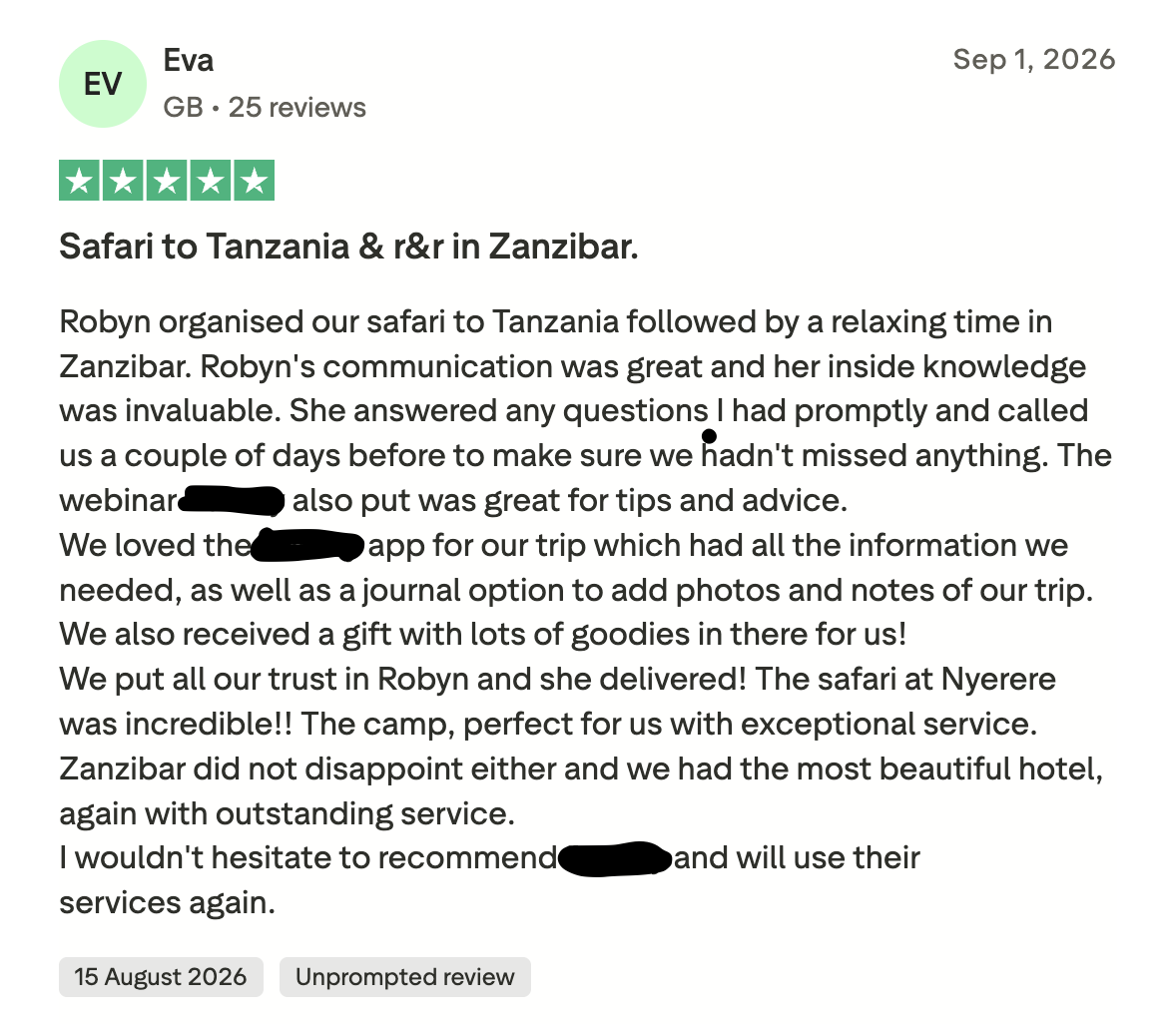
Plenty of travel brands say they have expert staff, first-class service and carefully crafted itineraries. Reviews tell you which of those claims customers actually experienced.
Look closely at repeated themes rather than just isolated praise. If one reviewer mentions a helpful travel specialist, that’s nice. If 50 people mention how knowledgeable the team was, how quickly they responded or how well problems were handled while they were away, you’ve probably found part of the competitor’s real advantage.
Then compare it with your own reviews. Are your customers praising the same things? Are there strengths they mention that you barely talk about in your marketing? Are competitors consistently being credited for something you claim to do just as well?
If a rival’s five-star reviews are full of praise for responsive specialists while yours mainly talk about the destination itself, there may be a service gap. Or it may simply be that you’re doing something well but failing to make it memorable enough for customers to notice.
Either way, that’s a greater insight than ‘their reviews are better than ours’.
A bigger budget doesn’t tell you what’s working
A competitor seems to dominate search, social and display, so the easy conclusion is that they simply have a bigger budget.
Sometimes they do. But a bigger budget can also hide a lot of waste.
Take a large travel brand bidding heavily on a broad term such as ‘luxury holidays to Greece’. It may have the spend to maintain a solid presence there, but that traffic can include people at very different stages of the booking journey, with very different budgets and very different ideas of what ‘luxury’ actually means.
A smaller specialist might get far less traffic by focusing on higher-intent searches such as ‘private honeymoon itinerary Santorini and Crete’ or ‘luxury island hopping Greece private tour’. The volumes are smaller, but the person searching is giving you much more information about what they want.
If those searches convert into higher-value enquiries at a better cost per acquisition, the smaller campaign may be doing much stronger commercial work.
That’s why competitor spend needs to be viewed with a bit of suspicion. A rival may appear everywhere because they can afford to buy scale. That doesn’t tell you how profitable the activity is, how much wastage sits behind it or what happens once the click becomes a lead.
Check your own return first. Which campaigns bring in the most bookings? Which audiences convert well? Where are you paying heavily for weak leads? Where can you afford to be more aggressive because the margins justify it?
Sometimes the smartest response to a bigger competitor is to stay out of the expensive fight they’ve chosen and put your budget somewhere the intent, product fit and likely return are stronger.
Find the parts they’re neglecting
A large operator might dominate broad searches for Costa Rica holidays, but that doesn’t mean they’re unbeatable. Their advantage may simply be scale: more authority, more budget and more pages covering the destination.
That still leaves plenty of room for a specialist to be far more useful to a particular traveller.
Take someone planning a family wildlife trip. They’re probably not looking for another generic overview of Costa Rica. They want to know which areas are best with children, how much travelling is involved, which lodges actually work for families, what wildlife they’re realistically likely to see and how to avoid an itinerary that leaves everybody shattered by day three.
The same applies to self-drive trips, birdwatching, honeymoons or multi-generational holidays. A big operator may cover all of those audiences somewhere, but often only at a fairly broad level. A specialist has the chance to go much deeper and make the traveller feel that the trip has been designed for somebody exactly like them.
That advantage can show up well beyond SEO. A larger brand’s paid social might be beautifully produced but aimed at everybody. Its email programme might push the same deals to huge chunks of the database. Its itineraries may be built around what sells at scale rather than what suits a particular traveller best.
That’s where smaller travel businesses can be awkward competitors.
Smaller specialists can often move faster and go much deeper on a destination, giving customers direct access to people who know the product inside out. They can also afford to build content and itineraries around smaller but potentially more valuable pockets of demand that wouldn’t make commercial sense for a business chasing volume.
The real opportunity in competitor analysis is finding those areas where the bigger player has left something on the table. If customers are searching for a more specific trip, asking questions the competitor barely answers or looking for flexibility their product can’t provide, that’s a gap worth paying attention to.
And it’s a much more sensible fight than trying to beat a much larger brand at being large.
Your competitors say ‘jump’, don’t say ‘how high?’
There’s a point where competitor research becomes competitor obsession.
They write about Iceland, so you write about Iceland. They launch on TikTok, so you launch on TikTok. They bid on your brand, so you bid on theirs. They knock £100 off a holiday, so you knock £150 off yours.
Congratulations. Your marketing strategy is now being run by somebody else.
Competitor intelligence should help you spot missed demand, weak points and commercial opportunities. After that, the focus has to come back to your own customers, product and numbers.
Look for the gaps where you have a credible reason to win the traveller over, then put your budget behind the ones most likely to generate profitable bookings. That’s a far better use of competitor research than trying to beat every rival at everything they do.


