We Brits love nothing more than a good old moan about the weather. Give us some sunshine and it’s too hot, a dumping of rain and it’s too wet. Too cold, too dry, too windy – we’re rarely happy.
This summer, however, it's become more than conversational filler. Record heat across some parts of the UK, alongside much more serious heatwaves and wildfires in parts of southern Europe, has made the weather a hotter topic than usual.
Little wonder then, that many people are looking at destinations with cooler climes for their annual break. Many of us in the travel sector have heard about the rise of the ‘coolcation’ (holidaying in places with much lower temperatures in the summer) but let’s look at some key stats from 2025 and 2026 more closely.
- Trip.com Group reported a 74% year-on-year increase in searches connected with cooler destinations and coolcations from the start of 2026. Its data showed greater interest in Iceland, Norway, Slovenia, Switzerland and Wales.
- The European Travel Commission found that climate considerations now influence the travel behaviour of 76% of Europeans. Among those adapting their plans, 16% seek milder temperatures and 15% avoid destinations prone to extreme heat or check the forecast before booking.
- As reported in The Independent, travel insurers Staysure recorded a 24% rise in travel insurance policy sales for trips to Norway in the first half of 2026 – a rise from tenth to seventh place in the company’s destination ranking. Iceland policy sales similarly increased by 18%.
- Booking.com accommodation search data also shows an increase of global searches to Slovenia (+29%), Norway (+33%) and Finland (+27%) during the peak travel months of 2025, compared to the year prior.
- SAS reported that summer 2025 bookings from Spain, Italy and France to the northern Swedish cities of Umeå and Luleå rose by 50% to 60%. Searches from France to Scandinavia increased by 46%, while searches from Spain rose by 28%.
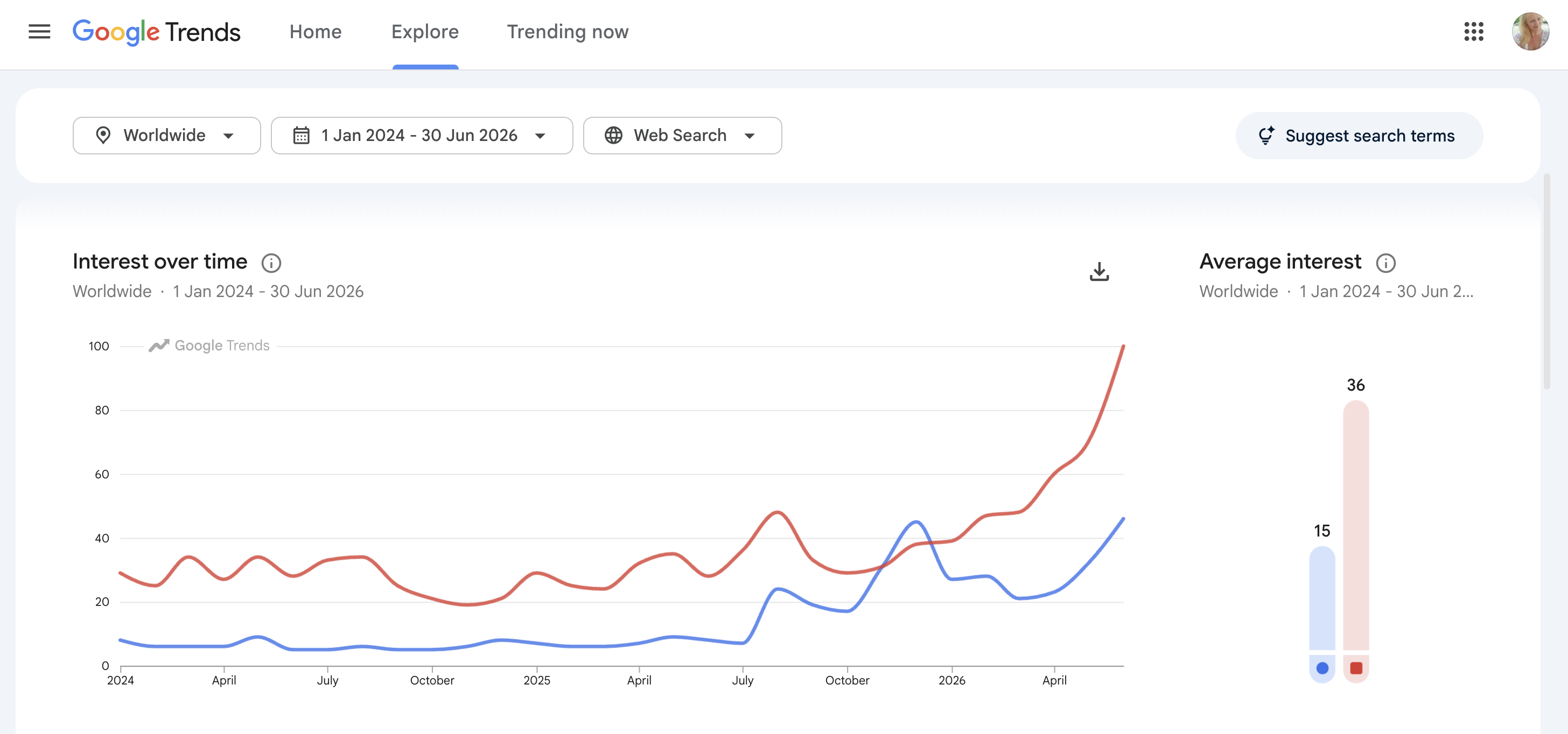
This Google Trends chart offers another useful signal. Worldwide interest in ‘Scotland holiday’ and ‘Norway holiday’ (as examples of coolcation destinations) climbed sharply during the first half of 2026. Scotland reached a score of 100 at the end of June, while Norway ended the period well above most of its 2024 levels.
There may be another factor behind Norway’s rise in interest too: a certain Mr Erling Haaland. Norway’s World Cup run, along with Haaland's prominent social media presence, gave the country a considerable burst of global attention, with Euronews reporting a 300% year-on-year increase in English-language searches for ‘Norway’. Now, we can't claim the rise in ‘Norway holiday’ searches is solely down to Haaland, or that all that interest will turn into bookings. But it does serve as a useful reminder that search trends rarely have one neat explanation.
It's important to note that none of this means Spain has been swapped for Scandinavia en masse. Southern Europe remained the fastest-growing European tourism region for summer 2026, with Greece, Spain and Italy recording particularly strong demand. The change is happening at the edges of a very large market, but those edges can still be commercially significant.
Look beyond the word ‘coolcation’
Very few customers are likely to search for ‘coolcation package holiday’ and then move neatly towards a booking. Their searches will usually be more specific.
Families may look for European holidays that are cooler in August. Walkers might search for destinations where daytime temperatures stay below 25°C. Older travellers may want to know about shade, night-time temperatures or the likelihood of disruption. Other people will stay within a country they already know, moving from Andalusia to Galicia or from the Italian coast to the Dolomites.
This is where the real search opportunity sits. Travel brands should look closely at Search Console data, paid search terms, internal site searches, live-chat conversations and call notes. The aim is to spot the questions and concerns that sit behind the wider trend.
Are people worried about sleeping in the heat? Do they want walking conditions rather than general temperature averages? Are they looking for somewhere cooler during the school holidays? Are they nervous about wildfires or disruption?
A single coolcations page may attract some traffic, but it won’t answer every question people have while they’re choosing a trip. The stronger content opportunity is likely to sit across destination pages, itinerary pages, FAQs and seasonal guides.
Use the weather to time campaigns
Travel brands have long used lousy UK weather to sell sunshine. A wet Bank Holiday is usually followed by a flood of emails featuring beaches, pools and curiously empty stretches of sand.
The same thinking can work the other way around. Brands with flexible availability could monitor prolonged heat in their main customer markets and change what they promote accordingly. A heatwave across southern England may increase interest in Scotland, Norway or cooler parts of mainland Europe. Similar conditions in Spain, Italy or France may affect demand from those markets too.
This doesn’t mean rebuilding a paid campaign every time the temperature hits 30°C. It does, however, mean watching whether changes in the weather are followed by changes in searches, enquiries and bookings.
Over time, some travel businesses may begin to see clear patterns. Demand for certain destinations might rise after several days of extreme heat. The effect could be stronger among families or older travellers. It may also disappear quickly once temperatures fall.
Brands working several months ahead on fixed campaign plans may miss those short bursts of demand. Having approved creative, suitable landing pages and a small amount of flexible media budget ready to go could make a real difference.
There also needs to be some common sense around climate emergencies.
Wildfires in France and Spain forced more than 300,000 people to evacuate or leave their homes in July. Any marketing activity running during an active emergency needs to be handled with great caution. A badly timed email inviting people to ‘escape the heat’ could come across as crass when communities are dealing with evacuations, lost homes and damaged livelihoods.
Brands should agree in advance when weather-led campaigns will be paused and who makes that call.
Start with the countries you already sell
Cooler summer holidays don’t always require a whole new product range. Many travel companies may find the best opportunity within countries they already feature.
Italy can mean the Dolomites as well as Puglia. Spain has Galicia, Asturias and the northern coast. France has Brittany, Normandy, the Alps and the Jura. Austria and Switzerland already have strong winter recognition, but their stunning lakes and mountain resorts can work just as well for summer travellers looking for milder temperatures.
This route has some obvious advantages. The brand may already have destination authority, supplier contacts and useful website content. Customers will also recognise the country, even if the region is less familiar.
The way products are presented may need some thought though. A visitor looking at Italy in August shouldn’t necessarily see the same recommendations as someone travelling in May.
Website recommendation panels could change depending on the month someone is browsing while filters might include average daytime temperatures, night-time conditions and suitability for walking or cycling.
There’s also the question of availability and price. Rising demand for Nordic and mountain destinations may lead to higher accommodation and transport costs, particularly during the school holidays. Smaller places can run out of suitable rooms quickly too.
Travel brands need to look at what can actually be sold at a sensible margin. A jump in traffic is far less exciting when there’s no suitable product available or the final price sends people straight back to the Balearics or Corfu.
Give people clearer weather information
Most destination pages include an average monthly temperature table. It’s useful, but it rarely tells the full story.
A customer may want to know whether the temperature drops at night, how conditions differ between the coast and inland areas or whether air conditioning is common in local accommodation. Someone planning a walking holiday may care about exposed trails, humidity and the number of daylight hours.
This information should sit close to the itinerary, departure dates and booking options. If it’s buried in a general inspiration article, you run the risk of visitors leaving the site to find the answer elsewhere.
Useful detail can also help a brand stand out without competing on price. A page that properly explains the differences between Bergen, Lofoten and inland Norway in August gives customers something they can use. A vague paragraph promising ‘refreshing escapes amid spectacular scenery’ gives them (and LLMs) very little.
Don’t move the same problems north
Like most popular holiday spots, cooler destinations can’t take unlimited visitor growth without feeling the effects.
Norwegian communities including Lofoten and Geiranger have raised concerns about congestion, rubbish, emergency access and pressure on natural sites. Smaller Nordic destinations may lack the roads, parking, public transport and accommodation needed to cope with a rapid increase in visitors.
Travel brands can help spread demand by promoting lesser-known bases, longer itineraries and travel outside the busiest weeks. They should also be careful with sustainability claims. A holiday doesn’t automatically become environmentally friendly because the traveller packed a fleece.
The longer-term opportunity may be wider than sending more people north in August.
Some travellers may continue visiting Spain, Greece, Italy and Portugal but move their trips to May, June, September or October. Northern and mountain destinations could then take a larger share of peak summer travel.
That has implications for product planning, pricing, staffing and advertising. Travel brands may need to rethink when they promote certain destinations, rather than simply adding a new seasonal campaign.
Final thoughts
Coolcations won’t redraw the map of European tourism overnight. They are, however, making temperature a bigger part of how some customers choose, search for and book a holiday.
The opportunity for travel brands extends beyond publishing a page about the latest trend. It lies in better weather information, more responsive campaigns and smarter promotion of the destinations and regions they already sell.
The forecast now influences search demand, campaign timing, product planning and website content. That’s quite a lot of responsibility for the subject we usually reach for when nobody knows what else to talk about.