Imagine checking a Google Ads account on a Monday morning and discovering that more than £11,000 had been spent on searches for a single competitor in just a few days.
That's exactly what happened to one of the accounts we manage at Adido.
The account had been running for 15 years, with a substantial amount of historical data and millions of spend behind it. You might think that after that length of time, Google would have a pretty good understanding of which searches are likely to generate valuable leads.
Apparently not.
The extra gut-punch was that nothing in its recent performance suggested this was about to happen.
It's an extreme (and expensive!) example of what can happen when Google's automated advertising systems are given too much free rein. And it's far from the only occasion when we've found ourselves questioning Google’s actions.
Don’t get me wrong - Google Ads automation can deliver excellent results, but recent experiences across some of our accounts have highlighted how quickly things can go wrong, usually without any obvious warning. And it’s happening more often in 2026.
How Google Ads spent £11,500 in four days
In September, we decided to make some changes to the keyword strategy of a long-standing client account.
A campaign targeting competitor search terms had performed well in previous years, but was no longer delivering the same results. We decided to remove it and allow relevant competitor searches to match with broad match keywords in other campaigns.
Initially, everything went according to plan.
For around 12 days, the competitor searches appeared in the other campaigns as expected. There was nothing to suggest a problem was lurking.
But then, one particular search term, associated with a business operating in a related but much broader market, started attracting considerably more spending.
Google was generating leads at a lower cost than elsewhere in the account, so its bidding system began favouring these searches.
But there was a snag.
Although the leads were cheaper, they were for generally poor quality and unlikely to generate a return. Google, however, continued splashing the cash.
Between Thursday and Monday morning, the account spent approximately £11,500 on searches associated with this one business. And with no tighter spending limits in place, Google was free to direct an increasingly large proportion of the available budget towards these searches.
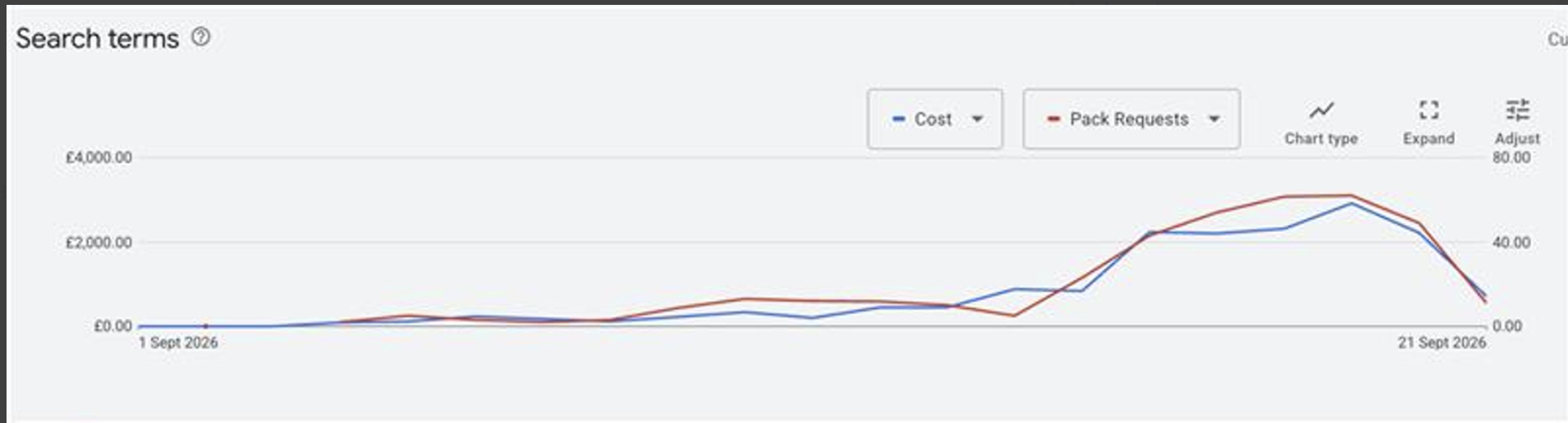
The campaigns were immediately stopped when the problem was identified, and we’ve since challenged Google directly over the spending.
But the incident raises a bigger question. How can an advertising system with years of performance data suddenly start prioritising traffic that's unlikely to deliver real business?
When cheaper leads come at a higher price
At the heart of this example is a problem with how Google interprets success.
The algorithm recognised that certain searches were generating leads more cheaply than others, so it directed more spending towards them. But a cheaper lead isn't necessarily a better lead.
Nowhere is this more applicable than the travel industry, where somebody requesting a brochure or making an enquiry might still be weeks or even months away from booking.
A campaign could generate 100 enquiries and look successful in Google Ads, but if hardly any become actual customers, there's little commercial value in those results.
If Google only knows that somebody has completed an enquiry form, it has limited information about what happened next. Did they make a genuine enquiry? Request a quote? Eventually book a holiday?
Without that information, the system can end up chasing conversions that look promising on paper but deliver very little revenue.
Google's August bidding change has added another complication
On 17th August, Google introduced changes to how certain automated bidding strategies work, particularly for campaigns that are limited by budget. These include campaigns using Target CPA and Target ROAS.
Previously, some budget-limited campaigns were performing better than the targets advertisers had set.
For example, a campaign with a target ROAS of 2, meaning £2 of recorded conversion value for every £1 spent, might have been achieving 2.2 or 2.3. Similarly, a campaign with a target CPA of £30 might have been acquiring customers for £25 or £26.
Under Google's updated approach, these campaigns are now more likely to deliver closer to their specified targets. But there's an obvious downside if your campaigns were previously exceeding those targets.
'Overnight, we spend the same money and we get worse results.'
We've seen this in one of our travel accounts where, without actual sales data being fed back into Google Ads (which is still sadly fairly common), different types of enquiries had been assigned estimated values based on their importance to the business.
When the campaign struggled to achieve even its relatively low Target ROAS, we removed the target and switched to Maximise Conversion Value, which has since helped improve performance.
The situation was further complicated by falling demand across the client’s sector, demonstrating how difficult it can be to separate Google's bidding decisions from wider market conditions.
Fewer conversions can also put greater pressure on sales teams, who have to work harder to turn a smaller number of enquiries into customers.
And, as we’re all painfully aware, increasing budgets isn't always an option.
Would you pay £83 for a single click?
Another example involves a client of ours in the luxury travel sector. We recently took over the management of their Google Ads account and began reviewing how the existing campaigns had been set up.
Some campaigns were using automated bidding strategies designed to help Google generate conversions. These strategies can be effective because they allow Google to adjust bids according to how likely somebody is to take a particular action.
For example, Google might decide that one person searching for a luxury holiday is more likely to make an enquiry than another. It can then bid more aggressively to show an advert to that potential customer.
In principle, this strategy makes sense.
The problem is that Google's assessment of what somebody might be worth isn't always accurate.
During our review, we came across some particularly eye-watering CPCs. One search for a semi-relevant click had cost £83.35. Another, for a similar term, had a click cost of £63.83.
And here’s the kicker. Neither resulted in a recorded conversion.
Now, luxury travel can involve substantial booking values, so a higher cost per click isn't necessarily unreasonable. Paying £20 or £30 for a click that results in a booking worth several thousand pounds could be perfectly justifiable.
But £83.35 for a single click that doesn't result in a recorded conversion?
Ouch.
Of course, it's impossible to judge the performance of an entire campaign based on two clicks. Even expensive clicks can be profitable when considered as part of a wider campaign.
However, these examples illustrate how much discretion automated bidding strategies can have when deciding what to pay for traffic.
How can travel marketers keep a tighter rein on Google Ads?
These experiences have prompted us to review some of our processes and introduce additional safeguards. Here are four things we'd encourage other travel advertisers to consider.
1. Maintain a robust negative keyword structure across the account
Negative keywords prevent ads from appearing for searches that aren't relevant to the business. They're particularly important when using broad match, where Google has greater freedom to decide which searches trigger an advert.
And this needs frequent attention. Even on a small account, it should still be done weekly. On bigger accounts, you should probably do it twice a week.
Regular search term reviews help identify unwanted traffic before it consumes substantial amounts of budget. As one our travel contacts recently observed ‘it’s like a never-ending game of whack-a-mole’.
2. Feed genuine lead and sales data back into Google
Importing offline conversions allows Google to see what happened after somebody clicked an advert and submitted an enquiry.
Instead of treating every form submission as a success, advertisers can identify which enquiries became qualified leads, resulted in quotes or eventually turned into bookings.
You’re effectively telling Google 'these are actual leads and actual sales. Look at these and aim for these. Find more of the same.'
Ideally, this should include actual quote and sales values, giving Google a better indication of the customers worth pursuing.
3. Check your bidding targets against actual performance
Google's August update means campaigns that previously exceeded their Target CPA or Target ROAS goals may now perform closer to those settings.
If you've historically achieved a CPA of £25 against a £30 target, it may be worth reviewing that target rather than assuming Google will continue delivering the same results.
It's also worth examining how conversion values are calculated. If you're relying on estimated lead values rather than genuine sales data, consider how accurately those figures reflect the business you're generating.
4. Check what Google could spend, not just what it usually spends
A campaign that has historically spent very little might still have settings that allow Google to spend substantially more.
Review the difference between actual spending and permitted budgets, particularly for campaigns using broad match or automated bidding.
Here at Adido, we’ve introduced additional scripts to monitor spending and budget changes across some of our larger accounts.
Automated alerts can help identify unusual spending patterns much sooner, reducing the risk of discovering a costly problem several days after it began.
Google Ads automation still needs the human touch
We're certainly not suggesting travel marketers should abandon automated bidding altogether. It can deliver excellent results when campaigns have accurate conversion data and clearly defined commercial objectives.
But our recent experiences should act as a cautionary tale of how much discretion Google's systems can have.
One account spent £11,500 in four days chasing poor-quality leads. Another was paying more than £80 for individual clicks. Elsewhere, changes to Google's bidding behaviour have made it harder to maintain previous performance without adjusting targets.
Google can make decisions based on the information it has, but it can’t really understand what makes a genuinely profitable customer.
And when those decisions go wrong, it's the advertiser who ends up considerably out of pocket.


