There’s no getting around it. The news coming out of the United States has been grim lately.
In the space of a month, two US citizens were shot dead by immigration officers in Minneapolis. Their deaths triggered nationwide protests, explosive political fallout and intense scrutiny of how force is being used by agents acting on the government’s orders.
This comes amid heightened tensions in US–EU/UK relations, which have taken a significant nosedive in recent weeks. Tariffs and diplomatic stand-offs have put everyone on edge and resulted in a steady stream of dystopian headlines - little wonder that so many of us are choosing to switch off the news and forego our bedtime doomscrolling.
Unfortunately, if you sell travel, you can’t just switch off. You need to be on the ball and ready to adapt quickly to evolving global situations. Which begs an important question for travel brands: with so much civil and international unrest happening right now, should we be advising against travel to the USA?
‘But we’re going to Orlando, not Minneapolis’
It might seem easy to view Minneapolis as a distant entity. It’s not New York. It’s not Disney World. Nobody’s expecting armed ICE agents to pop up on It’s a Small World or Space Mountain.
The worry is not that tourists will be targeted by design. It’s that they may be unwittingly caught up in something happening nearby, e.g. a protest or riot. And while Minneapolis is front and centre right now, who’s to say where tensions might surface next.
The small matter of the World Cup
Perhaps we wouldn’t be talking about this if it was any other year. But this isn’t any other year – there’s the small matter of the biggest sporting event on the planet taking place in the USA in just a few months’ time (and Canada and Mexico of course, but they’re not under the microscope here).
So rather than tourism being concentrated to the usual go-to hotspots, we’re going to see a whole lot of football fans flooding into cities across the country, some of whom are unlikely to align neatly with the Trump Administration’s preferred image of who should be crossing its borders.
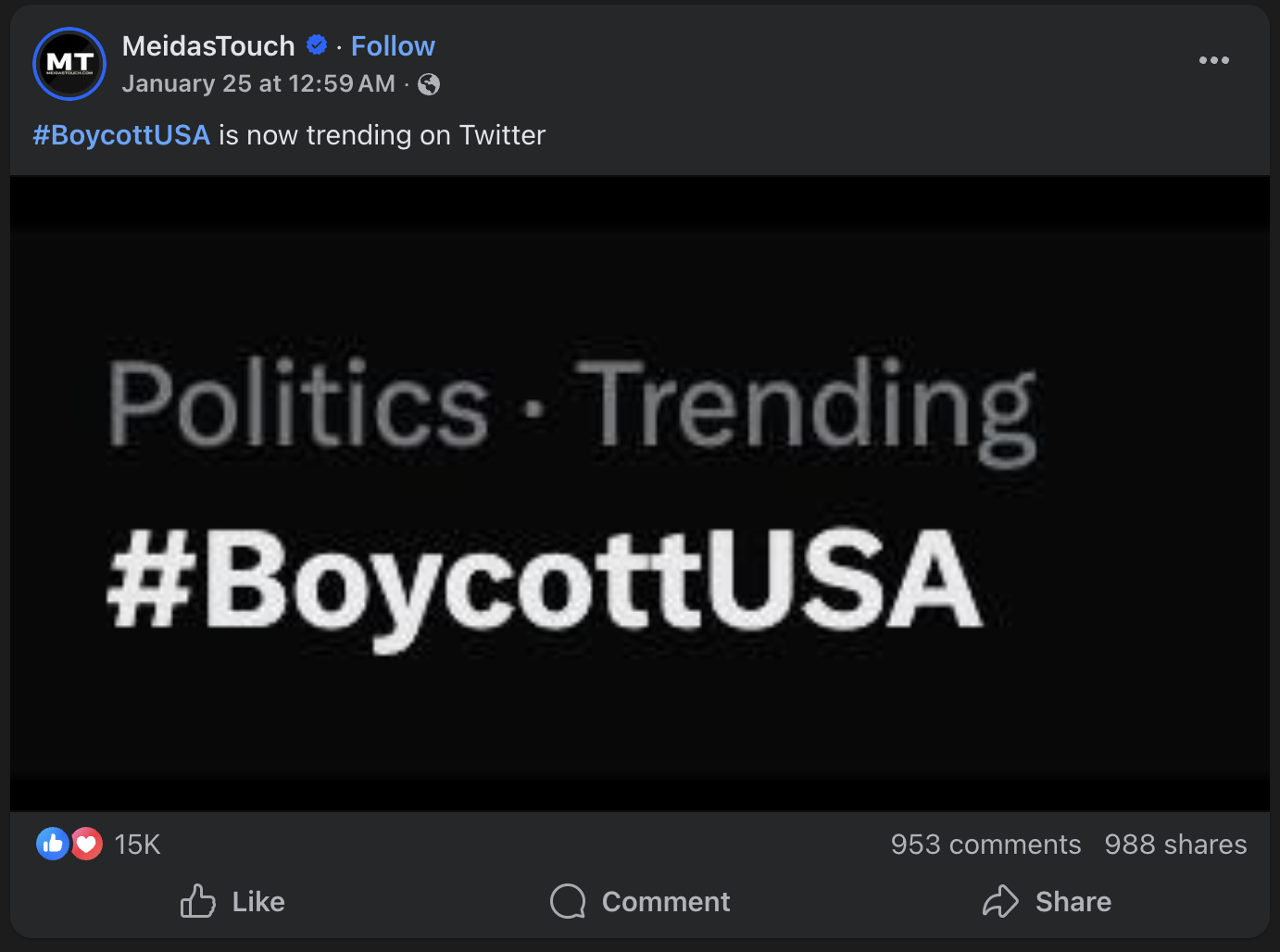
It’s undoubtedly paradoxical that a supposedly unifying global sporting spectacle is being hosted by an administration deeply suspicious of people moving across borders. Even former FIFA president Sepp Blatter has backed calls for fans to ‘stay away’. We’re also seeing #BoycottUSA trending across social media platforms, including the increasingly right-wing stomping ground X.
Here’s another worrying thing - having a ticket to a game won’t necessarily guarantee entry. Visa processing is inconsistent and vulnerable to sudden policy changes. Some supporters from qualified nations are banned outright. Others are technically permitted, but only if they fall into the right category, at the right moment, with the right paperwork and the right reception at the border.
Not the first problematic host nation
It’s not like we haven’t been here before in terms of questionable tournament host nations. Russia in 2018, followed by Qatar in 2022, didn’t exactly scream ‘global group hug’. Perhaps many of us felt to some extent relieved when the USA clinched the 2026 WC: ‘yeah, America has its problems – main one is calling football ‘soccer’ – but at least I’m unlikely to get shot for singing a rude song about its leader’.
Ahem.
It’s not really just about whether the USA in 2026 is ‘more dangerous’ than Russia in 2018 or Qatar in 2022. It’s also about arbitrariness.
Can travellers predict how they will be treated at the border? Should they be worried about their old social media posts being scrutinised? Can they assume that being near the wrong crowd at the wrong time won’t escalate into something potentially life-threatening?
Right now, the honest answer to all three has to be ‘we just don’t know’. Not a comforting phrase in travel.
So, should travel brands advise against travel to the USA?
In the current climate, and in light of recent events, I’d certainly suggest travel brands need to adapt their messaging around trips to the States – even for World Cup ticket holders.
To be clear, the USA is not a no-go zone. It’s not Gaza or Ukraine. But at the same time, it’s certainly not business as usual.
In moments like this, travellers don’t want to be misled into believing everything is tickety-boo. What they are looking for is sensible, practical advice and a guarantee that they’re in the right hands should something go wrong.
As Eve Moir of Travel Counsellors puts it:
I’m not advising clients to stay away from the USA, but like everyone involved in travel, I’m keeping a close eye on what’s happening over there. What I am doing is staying informed and offering reassurance to customers that should problems arise or tensions escalate, we’re there around the clock to offer support.
Reassurance can take many forms. Being at the end of a phone 24/7 is a big one. As is providing clear, up-to-date explanations of entry requirements and enforcement risks. Flexible booking terms will go a long way too.
In short, this isn’t about travel businesses saying ‘don’t go’. It’s about recognising that how brands behave during periods of unrest is remembered long after the headlines move on. Realistic framing rather than hard selling may cost bookings in the short term, but it’s proactive support, reassurance and considered messaging that will determine long term customer loyalty when the world feels steadier again.


