Welcome to our roundup of the latest SEO news! These are the stories that have caught our eye over the past month.
1. Google rolls out another Spam Update and adds multimodal reporting
Google rolled out yet another Spam Update in September, beginning on the 24th and applying globally across all languages. Google didn’t reveal any particular type of spam it was targeting (do they ever?), but this was already the fourth confirmed Spam Update of 2026 following updates in March, June and August.
On the same day, Google also introduced multimodal search reporting in Search Console. This allows websites to see traffic generated through visual search features such as:
- Google Lens
- Circle to Search
- Image uploads
- Chrome’s ‘Search this image’ tool
We still don’t get to see the exact images or visual queries that led users to our site, which would obviously be nice. However, we do get the familiar impressions, clicks and landing page data. This should at least make it easier to understand which pages are benefiting from visual discovery and whether image-led search is becoming a meaningful source of traffic.
.png)
2. Google changes travel search results across Europe
Google has started changing how some commercial search results appear across the European Economic Area as part of its response to the EU’s Digital Markets Act. Hotels, flights, trains and buses are among the areas affected, so this is one travel brands may want to keep an eye on.
For a search such as ‘hotels in Paris’, Google can now show a dedicated section featuring an online travel agency or comparison site, including prices, ratings and images, alongside a separate section for hotels selling directly. Users can also switch between different comparison providers within the SERP, giving these platforms more space while still keeping direct suppliers visible.
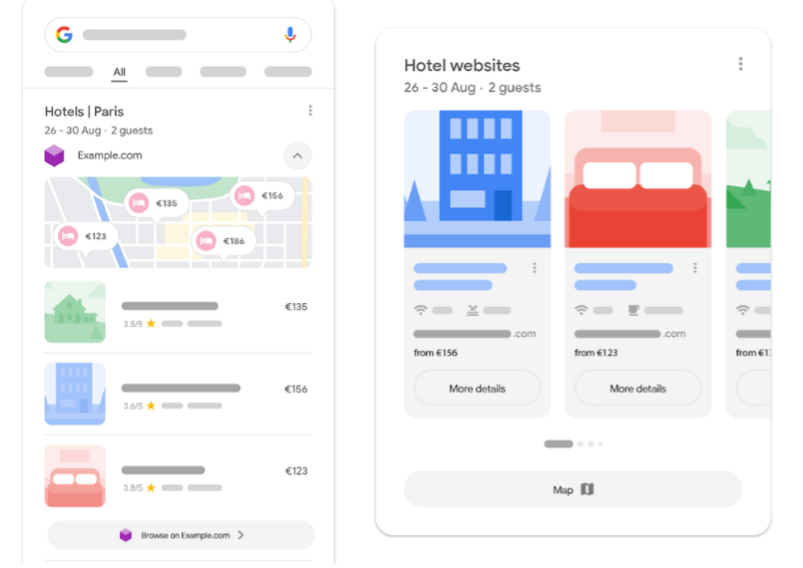
This could make the route from searching to booking a little more complicated, since the SERPs are likely going to look full and messy. You might still rank well organically, but Booking.com, Expedia or another comparison platform could be taking up more space elsewhere on the page. These new result types only appear within the EEA for now, so UK users may not see them, but they’re still worth watching, especially if your business mainly targets EU markets.
3. AI Overviews are appearing more on branded searches
AI Overviews are starting to creep into branded searches too! Ahrefs analysed 232.8 million US desktop SERPs and found that AI Overviews appeared on 61.3% of branded searches in July, rising to 65.1% in August and 73.3% in September. By 29 September, the daily figure had reached 82.9%.
This is an interesting change because branded search has traditionally been fairly safe territory. If someone searches for a hotel, tour operator or airline by name, you’d usually expect the company’s own website to appear front and centre. Now there’s a good chance Google may also throw an AI Overview into the mix, either above the organic listing or sometimes further down the page.
Ahrefs also found that Wikipedia, YouTube and LinkedIn were among the most commonly cited external sources within branded AI Overviews. This means reviews, press coverage, social profiles and general brand information across the web could all play a bigger role in what users see before they reach the company website.
-(1).png)
4. Could Google be preparing for a bigger crackdown on scaled AI content?
SEO guru Lily Ray has predicted that Google could be preparing for a larger crackdown on scaled, low-quality and manipulative content. There hasn’t been a confirmed ‘AI content update’, but the prediction is based on several changes to Google’s guidance alongside comments from Google employees. Google has recently placed more emphasis on manually reviewing and fact-checking AI-generated content, while its quality guidelines increasingly focus on effort, originality, skill and accuracy.
Remember that using AI itself isn’t against Google’s guidelines. The bigger risk is to publish large amounts of low-value content with very little human input.
There are also signs that some GEO tactics may already be losing effectiveness. Lily Ray found that Google AI Overviews cited 38% fewer self-promotional ‘best of’ articles in September than in June. When those articles were cited, the brand publishing the list was excluded from Google’s recommendations 83% of the time, while competitors were recommended in 70% of cases.
There’s no confirmed major update yet, so this is still just a prediction. But the direction seems fairly clear… AI can help create useful content, but using it simply to publish more content, faster, is unlikely to be a long-term shortcut.


