Welcome to our roundup of the latest SEO news! These are the stories that have caught our eye over the past month.
1. Google Search Console reporting issue (now fixed!)
Google Search Console gave everyone a bit of a reporting headache in April after Google confirmed that a logging error had affected impression data for nearly a year. The issue ran from 13 May 2025 to 27 April 2026, meaning some Search Console Performance reports may now look a little different after Google’s fix.
The good news is that clicks were not affected, so this doesn’t mean traffic suddenly dropped or that rankings disappeared overnight. The issue was with impressions, which also means related metrics like click-through rate and average position may look slightly off when comparing historical data.
This is especially important for travel brands or businesses where seasonal reporting relies so heavily on year-on-year comparisons. Whether you’re reviewing Easter breaks, summer holidays, cruise demand, destination guides or family days out, impressions alone may not tell the full story. Clicks, enquiries, bookings and revenue should be reviewed alongside Search Console data to give you the bigger picture. Basically, don’t panic over an impression dip without checking the other data too.
2. Google adds ‘back button hijacking’ to its spam policy
Google also updated its spam policies in April to lock down on something called ‘back button hijacking’. This is when a website interferes with the browser’s back button so users can’t easily return to the page they came from. Instead of going back as expected, they might be kept on the same site, redirected somewhere else or pushed into an experience they didn’t choose.
We don’t need to worry about normal pop-ups, booking prompts or standard marketing features. This spam policy targets manipulative behaviour that makes the site harder to leave or navigate naturally. Google has now made it clear that this can fall under malicious practices, emphasising that trust and basic user control all matter when it comes to your website.
For travel sites, this is worth paying attention to because they often have a lot going on! There’s booking widgets, offer overlays, newsletter pop-ups, comparison tools, cookie banners and third-party booking engines. None of these automatically fall under the spam policy, but they need to behave properly. Users should be able to browse, compare, go back, close a pop-up or leave a booking journey without feeling trapped. If a feature is designed to increase conversions but creates a frustrating or misleading experience, it could do more harm than good.
3. ChatGPT referral traffic is growing
AI search continues to be one of the biggest topics in digital marketing, but Semrush’s ChatGPT traffic analysis adds a bit more nuance to the whole 'is ChatGPT replacing Google?' conversation. According to the study, outbound referral traffic from ChatGPT to the wider web grew by 206% in 2025, which is an incredibly big jump and shows that people are definitely using ChatGPT as part of how they discover information online.
However, it’s not quite the end of Google just yet. Semrush also found that more than 20% of ChatGPT referral traffic goes to Google itself, while over 30% of all ChatGPT referral traffic goes to just 10 domains. On top of that, ChatGPT’s web search feature was enabled on 34.5% of queries as of February 2026, meaning a lot of answers are still not necessarily based on live web searches.
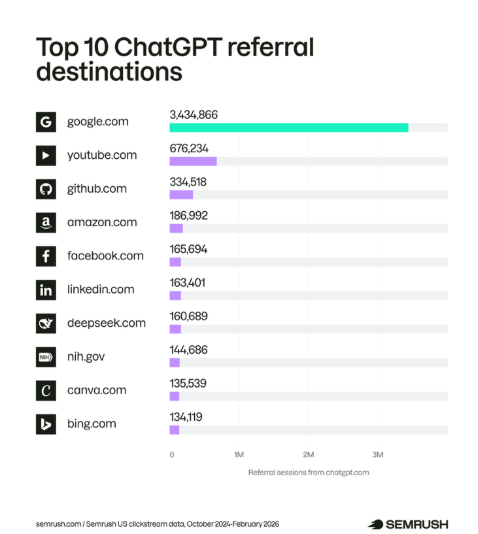
The takeaway is that the search journey is getting more fragmented rather than being completely replaced. Most ChatGPT prompts don’t even match traditional search terms so it’s likely users are using LLMs and search engines for completely different things. Someone might ask ChatGPT for itinerary ideas, destination comparisons or family-friendly holiday options, but they may still end up back on Google, review sites, travel agents or brand websites before making a booking.
4. Google’s travel data shows AI trip planning is becoming mainstream
Google’s latest travel data gives us a pretty clear sign that AI trip planning is no longer just a novelty. Search interest in 'AI travel assistant' and 'AI concierge’ has grown by 350% year on year, while 'AI flight booking' has increased by 315%. That’s a big shift in how people are thinking about travel planning and it suggests users are becoming much more comfortable asking AI tools to help shape their journeys (or are at least interested in how it might work).
Travellers are increasingly looking for help with planning their journeys such as where to go, when to go, how to get there, what to do, where to eat, how to save money, etc. Google has also been pushing AI-powered travel features, including custom trip planning with AI and an AI-powered flight deals tool.
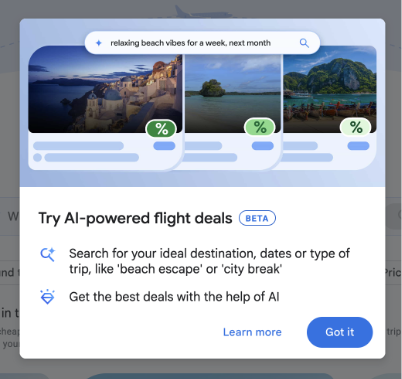
Source: Google Flight Deals
This means generic destination content may struggle to stand out. A basic page saying a place has 'pristine beaches, rich culture and something for everyone' probably isn’t enough anymore. Content needs to be more useful, structured and specific, covering things like suggested itineraries, seasonal advice, budget guidance, transport tips and all the good stuff people are asking AI to answer for them. As AI becomes more involved in the planning process, the brands that provide genuinely helpful travel information are more likely to be found, cited and trusted.
That's all for now - see you next month!


