Welcome to our roundup of the latest SEO News. These are the stories that have caught our eye over the past month.
1. Google had a busy month: May core update & more
Google has given us plenty to talk about in May, with a few updates that are worth keeping an eye on. First up, the May 2026 core update started rolling out on 21 May, which means ranking movement may have been a little more volatile than usual towards the end of the month. As always with core updates, this doesn’t mean a site has been penalised or that anything has necessarily gone wrong. These updates are broad changes to how Google assesses and ranks content, so the best thing to do is avoid panicking mid-rollout and review the data properly once things have settled.
Google also expanded Preferred Sources into AI Overviews and AI Mode, which could make brand trust and repeat readership more important in AI-led search results. In simple terms, if users choose certain websites as sources they trust, they may see more from those sites in Google’s AI experiences. That could be especially interesting for travel brands, publishers and destination specialists that rely on regular readers coming back for guides, inspiration and advice.
On top of all that, Google confirmed that FAQ rich results are no longer appearing in search from 7 May 2026. This doesn’t mean FAQs are redundant though! For travel sites, FAQs are still great for answering booking questions or queries about destinations and things to do. It just means they should be written for users and conversions, rather than treated as an easy way to win extra space in the search results. It’ll also be beneficial for answering conversational queries that show up in AI searches.
2. Google shares more guidance on optimising for AI search
AI search is still one of the biggest conversations in SEO, and Google added more clarity last month by publishing a new resource on how to optimise for its generative AI search experiences. The main takeaway is pretty reassuring, letting us know that we don’t need to throw traditional SEO out the window and start again. Google is still talking about many of the same fundamentals like:
- Creating useful content
- Making sure pages can be crawled
- Using clear structure
- Giving users information they can actually trust
However, the bar is getting higher. Google specifically mentions the importance of non-commodity content, which is especially relevant in travel because so much destination content online is at risk of sounding the same. A generic guide probably isn’t going to stand out in normal search anymore, let alone AI search. Travel brands should be thinking about content that is genuinely helpful and specific, such as first-hand destination advice, original photos, seasonal recommendations, transport tips and comparisons that help people make better decisions.
3. AI search traffic vs normal organic traffic
Search Engine Land published a really interesting piece looking at the difference between traditional SEO traffic and AI traffic. The big takeaway from the study is that AI search traffic does not always behave in the same way as organic. That’s important because we’re used to judging SEO performance through rankings, clicks, impressions and sessions, but AI search adds a slightly different layer. A page might perform well in Google’s normal search results but still not get picked up or cited by AI tools. On the other hand, a very specific answer page, tool or data-led guide might become more useful in AI search even if it isn’t the biggest organic traffic driver.
For travel brands, this could change how we think about content performance. It also creates a reporting challenge for agencies and marketing teams, since looking at organic sessions alone may not tell the full story. As search becomes more fragmented, travel brands may need to look at AI-referrals, brand mentions, assisted conversions, engagement with guides, direct enquiries, newsletter sign-ups and whether their content is appearing as a useful source in AI-led journeys.
4. Travel demand is still strong but people are looking closer to home
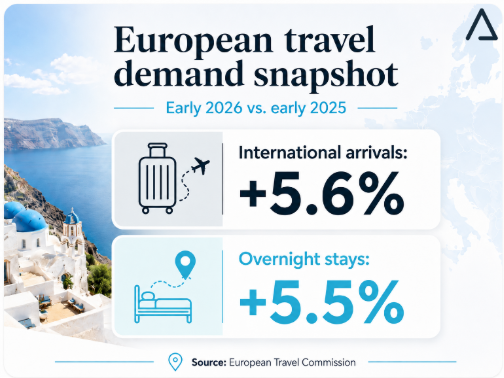
There were some useful travel trends in May that are worth tying back to SEO strategy. The European Travel Commission reported that international tourist arrivals to Europe were up 5.6% in early 2026, while overnight stays increased by 5.5%, showing that demand for European travel is still holding up well despite economic uncertainty and wider global issues. A big part of this is intra-regional travel, with European travellers continuing to travel within Europe rather than necessarily relying on long-haul trips. People still want holidays, but they are likely to be more considered about where they go, how far they travel and whether the trip feels worth the money.
And it’s not just happening in Europe. For UK travellers, the ‘stay close to home’ trend is, quite literally, hitting closer to home. Sykes Holiday Cottages’ 2026 Staycation Index says that 64% of Brits are planning a UK break this year, with young travellers helping to drive the trend. For travel brands, this creates a really clear content opportunity. If more travellers are weighing up cost, convenience and distance before they book, content needs to make planning feel easier, clearer and better value.
That's all for now - see you next month!


