Welcome to our roundup of the latest SEO news! These are the stories that have caught our eye over the past month.
1. Google’s March 2026 Core Update & Spam Update
March was a busy one for Google with two major updates rolling out back-to-back (within three days of each other!). First we had the March Spam Update, which focused on identifying low-quality or AI-generated content as well as manipulative backlinks and deceptive tactics that aim to gain rankings. This was a fast update rollout that was completed in under 24 hours with the hopes that the SERPs get a squeaky-clean refresh showing high-quality and relevant results for users.
Then a few days after, we were hit with a big one – Google’s March 2026 Core Algorithm Update. As usual with the core updates, the intention isn’t to target specific issues but for Google to refine its systems to improve how content is ranked based on relevance and usefulness. Together, these updates have caused a lot of volatility with some reports suggesting over 55% of websites saw ranking shifts during and after the rollout period. That’s a lot of fluctuation in a short space of time.
It continues to be important to focus on high-quality content that is genuinely going to match search intent and be useful for users, answering their questions and providing unique insights. For travel brands in particular, this raises the bar. Generic 'top 10 destinations' pages or AI-written guides might not make the cut, while original itineraries, first-hand experiences and content that is actually helpful may be more likely to rank.
2. Brand sentiment on Google AI Overviews vs ChatGPT
It’s a big question for companies everywhere at the moment - what are those AI bots saying about our brand? Are they even speaking (writing?) about our brand at all? Maybe you’ve had a little search to see what the LLMs 'think' and I would hope they had nothing but good things to say. However, you might get a different response depending on who you ask…
Brightedge found that Google’s AI Overviews were 44% more likely to show negative sentiment about brands in their answers than ChatGPT. While most mentions were seen to be neutral or positive, the difference is noticeable. Around 2.3% of brand mentions in Google AI Overviews were negative compared to 1.6% in ChatGPT, which might sound small, but at scale that’s a lot of users seeing critical commentary directly in search results.
It may be that Google tends to form its perception around news coverage, reviews and recent events where ChatGPT is more likely to generate comparisons or balanced summaries. While you can control brand messaging through your landing pages and website content, LLMs are pulling information from those areas and more. Reputation management across the entire web will be important to maintain a positive brand sentiment, which could look like responding to all reviews (good and bad) or focusing on positive press releases.
3. Google is rewriting search headlines with AI
Google has been experimenting with how it displays page titles in search for a while. We all know that sometimes the meta titles we provide aren’t always the ones that shows up on the SERPs. Yet it would take a sentence or phrase that could be found in your content (so I guess technically you still wrote it). However, more recently it’s been testing AI-generated headlines that replace or rewrite what publishers have written completely.
The issue with this is the context and control. Google may generate a version that it believes is a better match but really it misses the mark. Or you’ve spent hours carefully crafting a new set of meta titles for your landing pages, just for them to be altered afterwards. On the other hand, maybe it takes some meta titles that are a little bit longwinded and improves clarity.
Traditionally, meta titles were one of the most important elements for SEO and click-through rate. It’s where you could add personality, emotion and hooks to stand out in the crowded search results. But we’re heading towards lower click-through rates and less control over what users see on the SERPs, so optimisation may be shifting away from metadata and more towards overall content and relevance.
4. Travel is becoming more personalised and experience-driven
Travel behaviour in 2026 is increasingly centred around personalisation and meaningful experiences, rather than generic, one-size-fits-all trips. According to recent insights, travellers are no longer just booking holidays, they’re building trips around their interests, values and identities. This includes locations seen in films and TV shows, with 81% of Gen Z and Millennial travellers planning getaways based on what they’ve seen on screen.
It’s also about the big moments that leave you speechless. 41% of travellers say awe-inspiring experiences are a top priority in 2026, with 63% saying it’s the natural wonders that will guide their travel plans. This reflects a clear move away from traditional package holidays towards more curated, experience-led travel.
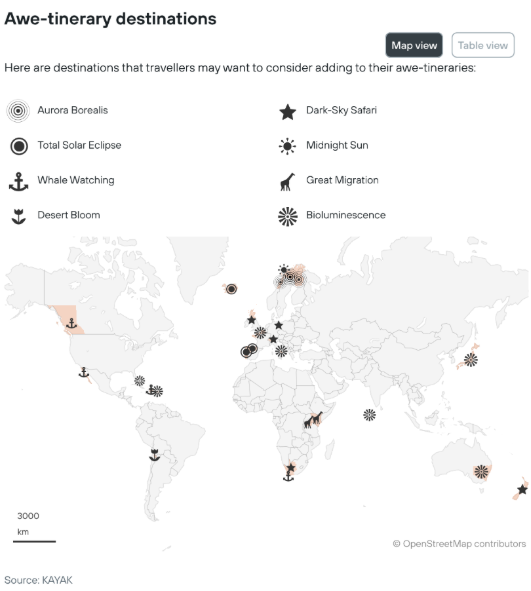
For travel brands, content needs to move beyond generic destination pages and instead focus on specific experiences, niche interests and tailored recommendations. The more closely content aligns with what travellers actually care about, the more likely it is to attract, engage and convert users.
That's all for now - see you next month!


