Welcome to our monthly roundup of the most relevant PPC news from the last month.
1. Search Query Reports may not reflect the actual searches
Search Terms shown in Search Query Reports may not always reflect the exact searches users typed. Instead, sometimes they represent Google’s closest approximation based on increasingly complex search behaviour, privacy thresholds, and AI-driven matching systems.
The update was spotted by Anthony Higman on an official Google Help page:
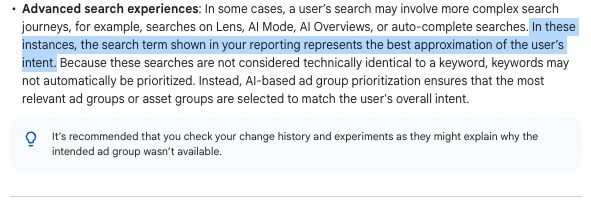
This change highlights how heavily AI now influences Google Ads systems and how integral it has become in connecting users with the most relevant ads based on inferred intent, context, and behavioural signals rather than just relying on exact keyword matching.
As a result, negative keyword management, query analysis, and match-type strategies may become more difficult and potentially less reliable than before, especially when interpreting Search Query Report data.
For the travel industry, this is important because search behaviour is often broad, inspirational, and intent driven. Users may search for ideas such as 'luxury beach holiday' or 'best honeymoon destinations' rather than specific destinations or packages. With Google relying more on inferred intent, it may be harder to optimise.
2. Google Ads is introducing Gemini powered dashboards.
Google is bringing Gemini into Google Ads dashboards as a tool for data visualisation, analysis and export. Dashboards will allow advertisers to explore data through charts, tables and ad graphs. They will be able to customise views simply by typing prompts, which will then provide real-time updates based on their queries.
This is important as data analysis has always required a manual setup and navigation across reports. This update changes that towards a more conversational model where you ask questions and get visual answers.
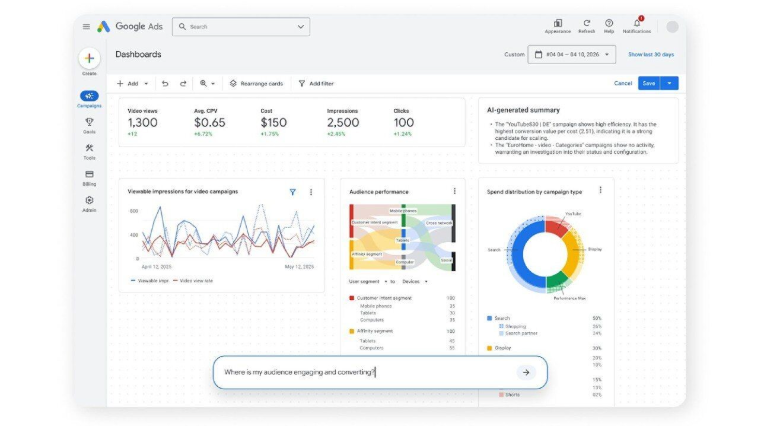
Dashboards will be able to display different key metrics such as impressions, clicks, video views and cost, alongside performance breakdowns across audiences, devices or campaign types.
Google says more details will be shared at Google Marketing Live.
For the travel industry, this could help analysing multiple destinations, seasonal trends, and audience segments. Travel brands may be able to identify performance shifts, booking trends, or high performing markets quicker.
3. Site Visits assets are official
Google has officially published new help documentation detailing site visits assets for ads. The feature was initially spotted in 2025 and again in March 2026, it is designed to show the number of visitors to a website as a way to strengthen credibility and potentially improve ad performance.
“Site visits is an automated asset that shows how many times your website has been visited. This non-clickable text appears directly in your ads, giving potential customers a clear metric of your site's popularity”

To be eligible for the site visits asset, you must meet the following requirements:
- Minimum of 10,000 clicks within the last 30 days.
- Your account must have no policy violations.
- Website must operate on a single-tenant domain or a unique subdomain that distinctly represents your business entity. Sites hosted on sub-paths of shared hosting domains are ineligible for the asset because distinct clicks cannot be separated from the primary hosting site.
Some of the benefits would be an increase in trust as it shows a verifiable metric and a boost in engagement as high visit numbers signal value
Trust plays a major role in travel booking decisions. Seeing high site traffic could help reassure users when comparing multiple options.
The official help page: About site visits assets.
4. Google updates budget pacing rules for scheduled campaigns
Google is changing how campaign budgets work when using ad schedules in Google Ads. Starting June 1, campaigns will aim to spend toward the full monthly budget cap (30.4 times the daily budget), even when ads are scheduled to run only on specific days. Previously, budget pacing was generally adjusted according to the number of days the campaign was active.

Now, Google will try much harder to spend the full monthly budget during those allowed hours. So, if your ads only run a few hours a day, spending could become much more aggressive in that time.
This could mean:
- Budgets running out earlier in the day
- Higher spend during scheduled hours
- More traffic/conversions in shorter periods
- Needing to adjust daily budgets or schedules
The change is basically Google pushing harder to maximise delivery within the time windows you allow.


