Search queries are getting longer.
At least, that is what I’m hearing time and time again at travel events and on LinkedIn.
The latest one doing the rounds is that search queries are now two or three times longer than they used to be, due in no small part to AI Mode which was rolled out last year. But is that actually true? And are longer queries more valuable than shorter ones?
It’s easy to take this stat at face value. After all, I think about how demanding I am with my own queries nowadays. Once upon a time, I’d simply type in ‘budget hotel in York city centre’. Now it’s more like ‘budget hotel in York city centre with bath not just shower, less than half a mile from train station. No more than £100 per night. Must have breakfast included’.
Such a diva.
This neatly fits the narrative around the supposed reinvention of search. But when I took a closer look at the data and started pulling it apart properly, what I was seeing appeared to tell a somewhat different story.
To be clear, I’m not trying to dismiss the notion that search behaviour is changing, because clearly it is. It’s more about exploring whether queries really are getting dramatically longer and, if they are, whether that is actually translating into clicks or meaningful traffic.
More searches, but not more clicks
I’ve been mulling over how I can demonstrate if search terms are 2x or 3x bigger. Is it total impressions year on year? Or clicks? Or a combination of the two? And against what baseline do I measure it?
A good place to begin is with how impressions and clicks are behaving across different query lengths, using aggregated Google Search Console data across 25 different travel sites year on year, looking at nearly 4 billion impressions and over 600,000 travel related clicks.
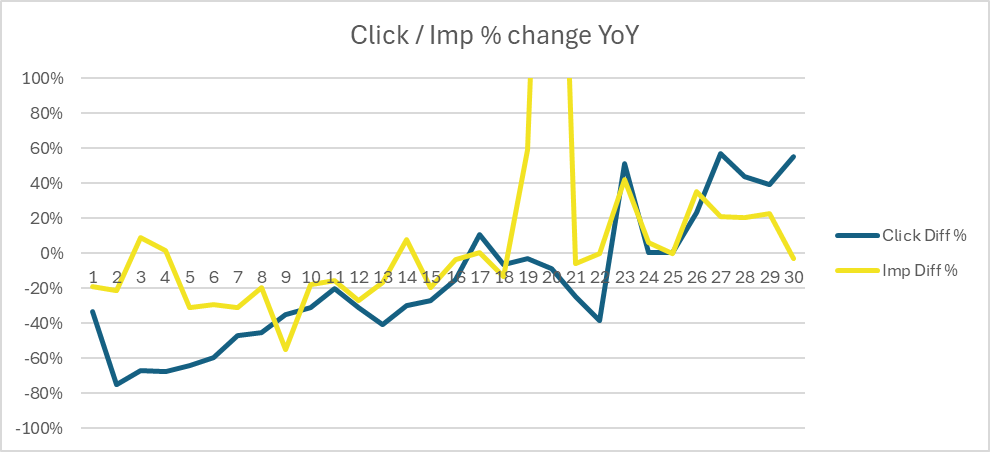
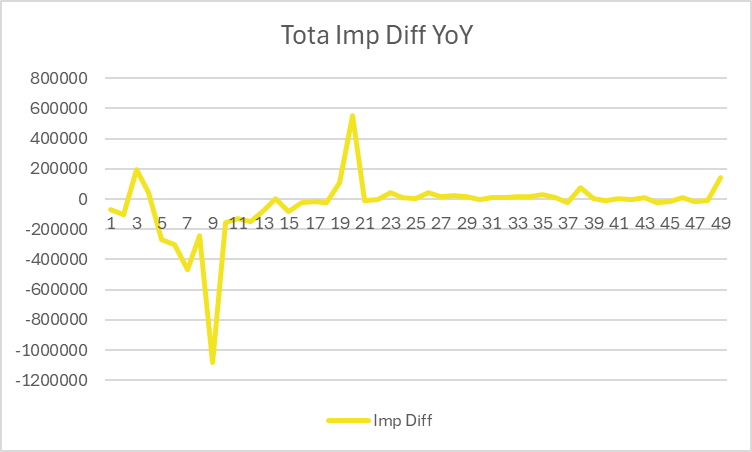
This graph shows year-on-year percentage change in both clicks and impressions by the number of words in a search phrase. At first glance, this certainly supports the headline that queries are getting longer, particularly when you look at the spikes in impressions at the higher word counts, especially after 20 words.
A headline of ‘increase of 2-3x search length’ is hard to quantify. What was the original? What is it now? To try and get a handle on an average as a start, let’s focus on the midpoint. In other words, at what query length do you reach 50% of all impressions across both years?
In 2025, that point sat at 8.64 words. In 2026, it’s 9.8.
So, if I use that as our benchmark, query length hasn’t doubled or tripled. It’s increased by around 13.4%, which is nowhere near as dramatic as the headline suggests.
On clicks, the midpoint actually drops from 3.75 words to 3.0, meaning that more people are clicking on phrases with fewer words, not more. That means half of all clicks are now happening on shorter queries than they were a year ago.
If you look at how those clicks build up over time, the picture becomes even clearer.
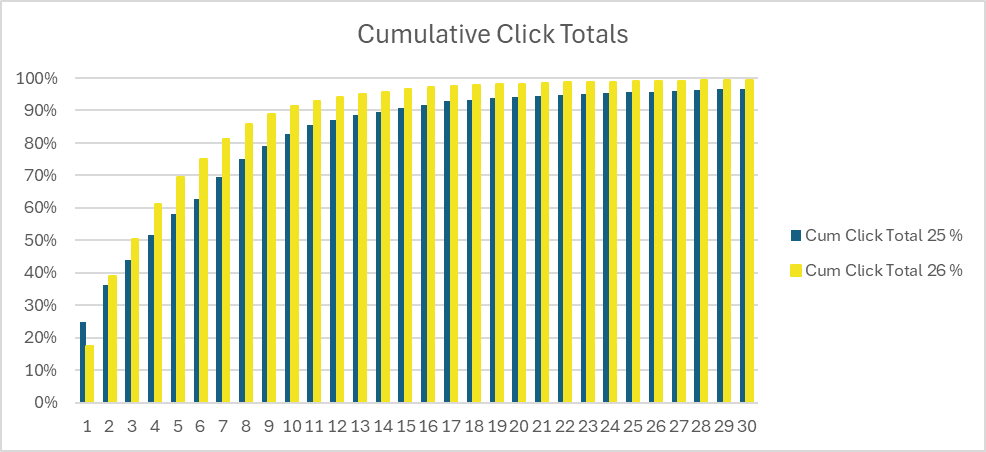
The cumulative click totals for both years track very closely. There are small differences, but nothing that suggests a wholesale redistribution towards longer queries. If user behaviour had fundamentally changed, you would expect to see a far more obvious divergence here.
So while longer queries may be increasing slightly in volume, the key takeaway is that they are not translating into proportional click growth.
Shorter queries still dominate
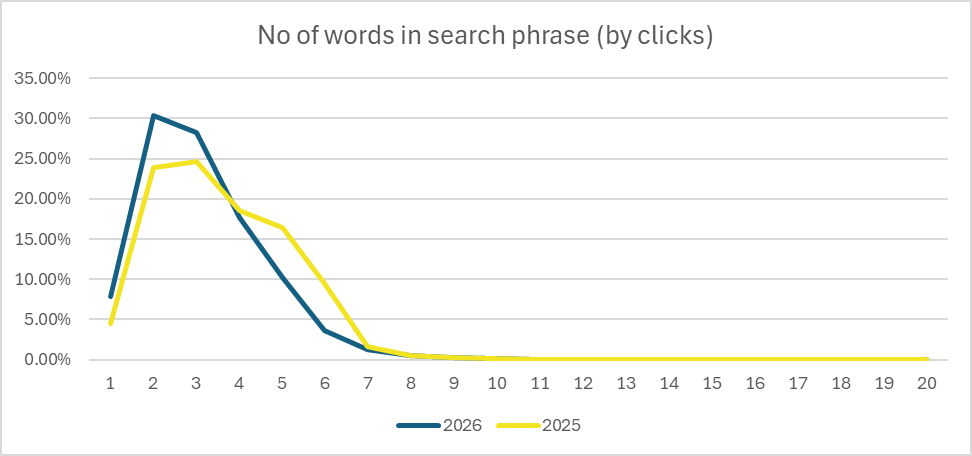
My research found that short phrases still dominate when it comes to clicks. In fact, the 2026 line suggests that concentration is, if anything, a little stronger than it was before. The yellow line sitting higher across those slightly longer word counts indicates that more of the click activity was happening there previously, but is now more concentrated on shorter queries, again counter to what the headlines suggest.
Then if I look at how many words are searched and the impressions they generate, the graph is also very similar year on year.
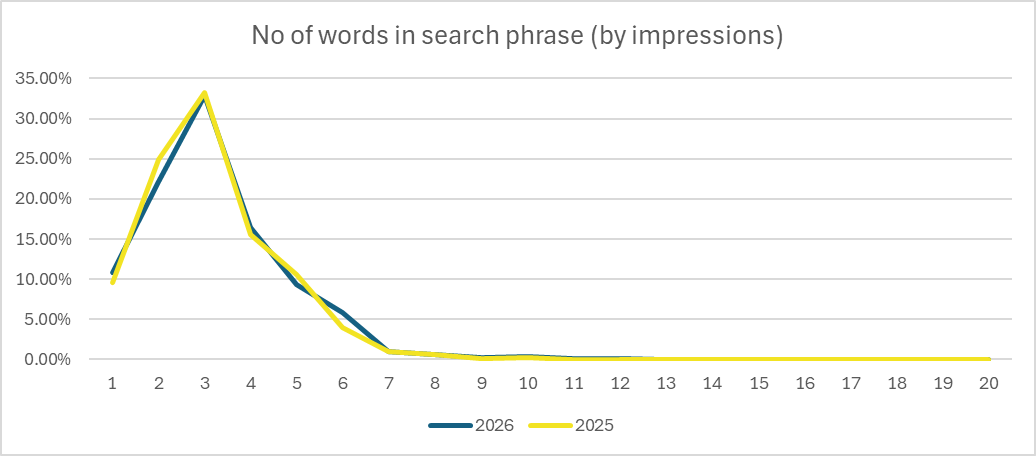
The problem is that impressions alone don’t tell us whether those searches are valuable, whether they lead to visits, or even whether they all reflect real human behaviour.
And that is where the bigger issue starts to emerge.
CTR is falling
The real problem is that CTR is WAY down across the board. Not just for long queries, not just for a handful of positions, but pretty much everywhere.
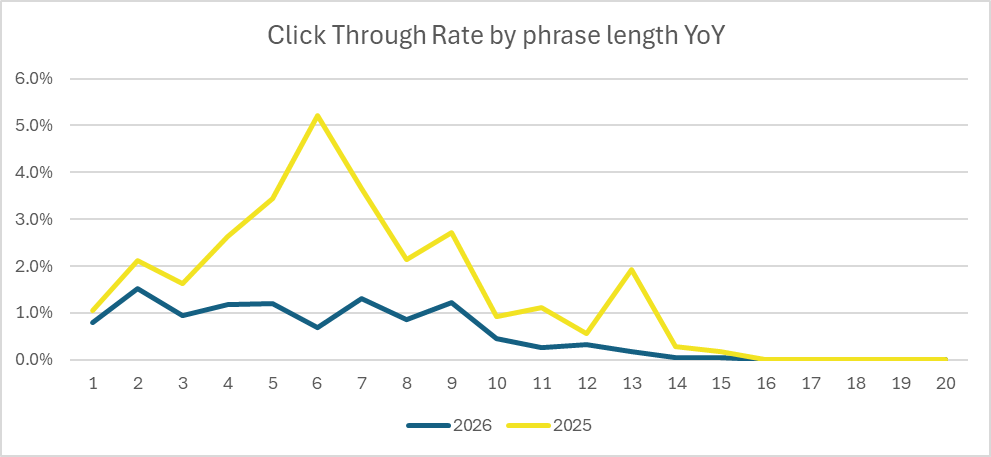
This matters far more than whether the average query length has crept up by a word or two, because a lower CTR means fewer visits regardless of how visible you are. You can hold rank, improve rank and increase impressions, but if people aren’t clicking (mostly because of Googles pushing of AI Overviews), the end result is still weaker traffic.
Rankings are improving… but traffic isn’t
Once you start looking at the rest of the data through that lens, a lot of things that felt confusing begin to make more sense.
Take rankings versus traffic, for example.
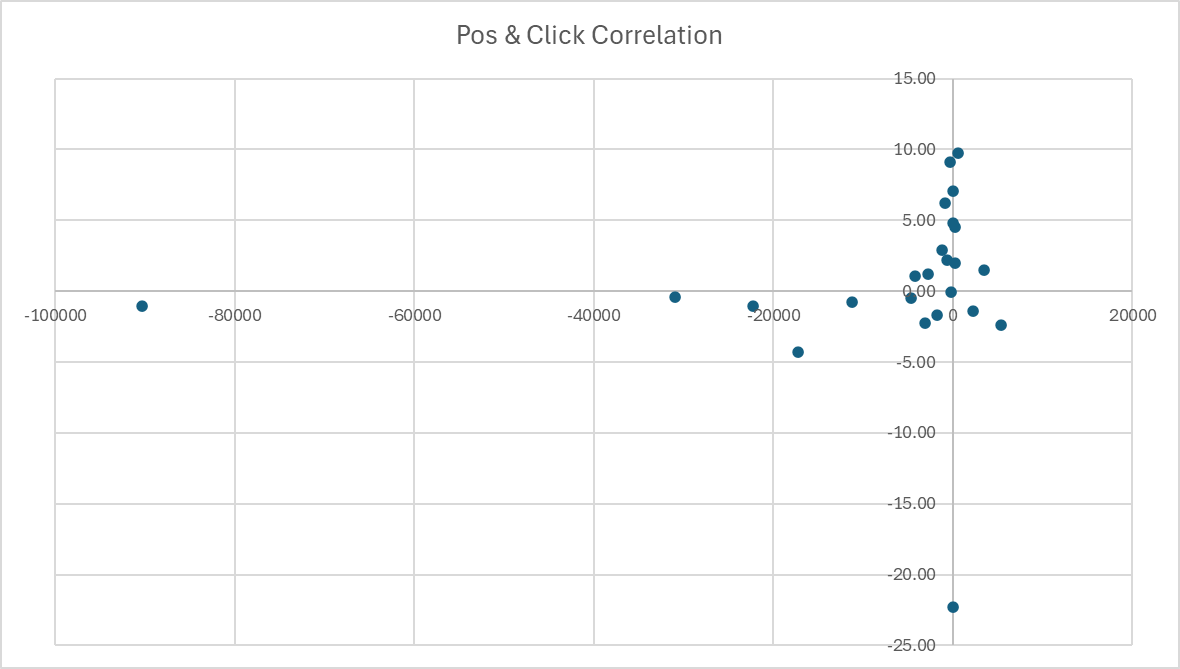
This is another way to view the data where we can look at average position change year on year and also the traffic drop on two different axes.
Here, we would normally expect to see a fairly clear relationship. If rankings improve, traffic should follow. However, in the main, our clients have actually gone up in rankings but their traffic has barely moved. Although in a world where clicks are dropping, rankings have to increase to maintain existing levels
The big outlier is a Greece-focused travel client of ours who has seen a significant drop in traffic (due to market changes than anything else), but in the main, most sit in that uncomfortable middle ground where positions are better and traffic is not.
Brand terms are also under pressure
The same pattern shows up when you look at brand performance.
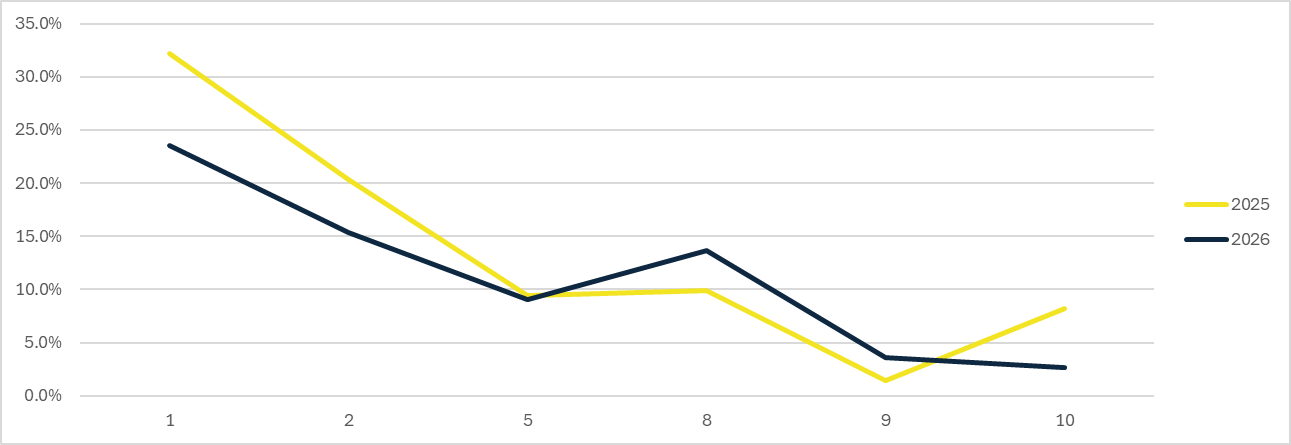
Even where positions remain stable, traffic is falling. Brand terms, which have traditionally been a safe bet for strong click performance, are not immune. Again, that points back to CTR rather than query length as the underlying issue. The average of our 25 travel brand search terms was a staggeringly big drop of 54.6% in 2026 compared to 2025.
Position one is not what it used to be
And if there was any doubt about how much the SERP has changed, the final two charts put it to bed.
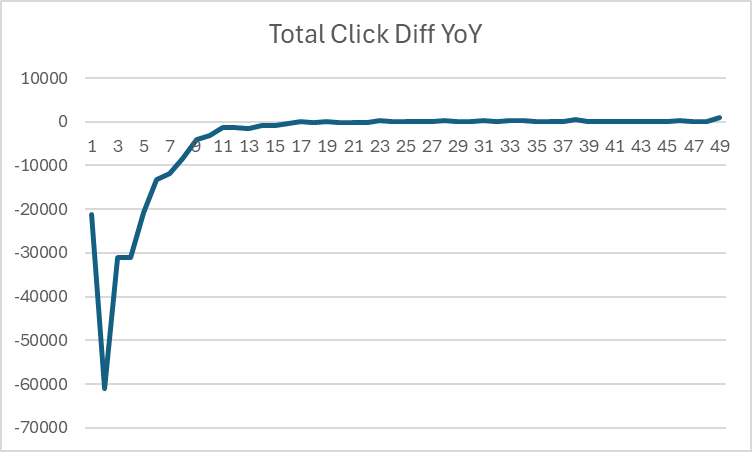
Across both impressions and clicks by position, even the top spots have taken a hit. Position one is not delivering what it once did, and the same applies further down the page. Ranking well still matters, but it doesn’t carry the same expectation of traffic that many of us have been used to.
So where does the ‘2x or 3x longer’ claim actually come from?
At this point, it’s worth properly addressing the headline claim that search queries are getting two or three times longer. Because depending on how you choose to measure it, you can make the data say almost anything you want.
If you take a sensible, grounded view and look at the 50% midpoint, there’s very little movement. As I covered earlier, impressions move from 8.64 words to 9.8. That’s not a substantial leap.
So where does the big number come from?
If we take anything over, say, ten words as an arbitrary definition of a ‘long’ search, then yes, there is a big increase. Impressions jump from 2,425 to 16,487, which is a 580% rise. This is the sort of number that grabs attention and makes for a great soundbite on LinkedIn.
Those same queries go from 17 clicks to 36, which is an 111% increase. Technically still growth, but nowhere near proportional to the surge in impressions.
If longer searches were genuinely driving behaviour in the way people suggest, you would expect clicks to follow that same trajectory, but they don’t. This suggests users may be getting the answers they need directly in the SERP, rather than needing to click through. And honestly, do you want to focus on getting 36 clicks on long tail phrases compared to the many thousands you get on more traditional search terms and positions? Thought not.
How clean is the data we are looking at?
We can only work with the data Google provides and that in itself poses a problem.
Google Search Console is supposed to filter out bots and scrapers so that what we see reflects real user behaviour. In most cases, it does a decent job. However, there are some examples in the data that suggest that’s not always the case.
During some weeks this year, impressions for certain phrases went up into the tens of thousands per day. Why would that happen? Why would one very specific phrase go from a few hundred searches per day and then spike for seemingly no reason, before returning to normal levels?
You also see queries that are, let’s say, highly engineered. Things like long strings of exclusions:
‘-site:facebook.com -site:youtube.com … hilton athens greece’
Or ultra-detailed prompts that read more like something fed into an AI tool than typed into Google by a human being.
“i am a 55-64, 65+, or 45-54 year old. my main motivations: curious about cruising but seeking reassurance. motivated by ease, comfort, and the promise of seeing multiple destinations without logistical stress. wants to understand daily life onboard, excursion quality, dining experience, and overall atmosphere. values transparent, relatable guest experiences that build confidence. my main pain points: concerned about seasickness, crowding, feeling confined, or losing independence. unsure whether cruising will feel overwhelming or too rigidly scheduled. struggles to visualize the real experience from marketing materials alone. hesitates without firsthand accounts that address common first-time cruiser fears. which cruises offer the most cultural european experiences?".
This doesn’t prove anything definitively, but it does raise questions about whether all impressions reflect genuine human search behaviour.
A slightly cynical take (tin hat firmly on)
And then there’s the more cynical angle.
If longer queries are increasing, even if some of that increase is influenced by automated tools, it feeds a very convenient narrative.
‘Search is changing. Queries are getting longer. You need to adapt. Keep up, luddite’.
Which, whether intentional or not, keeps the spotlight firmly on AI, automation and the next evolution of search.
That doesn’t mean the data is wrong. It just means it is worth questioning how clean it is, and how it is being interpreted.
Final thoughts
There’s clearly something going on with search behaviour, but it’s not as simple as saying ‘queries are getting longer’.
Yes, there’s growth in longer, more detailed searches, and at times it does feel like people are treating Google more like a conversation. But when you look at the data as a whole, it’s hard to argue this is the dominant (or even really growing) behaviour or that it’s driving any meaningful traffic.
In light of this, what stands out far more is how the relationship between visibility and clicks is changing.
It also raises questions about what we’re actually measuring. If some of these longer queries are being influenced by tools or automation, then we’re not just looking at human behaviour. We’re looking at a mix of both.
For SEOs, that moves the focus away from query length and towards understanding how SERP features, AI responses and user behaviour are impacting whether a search results in a click at all.


